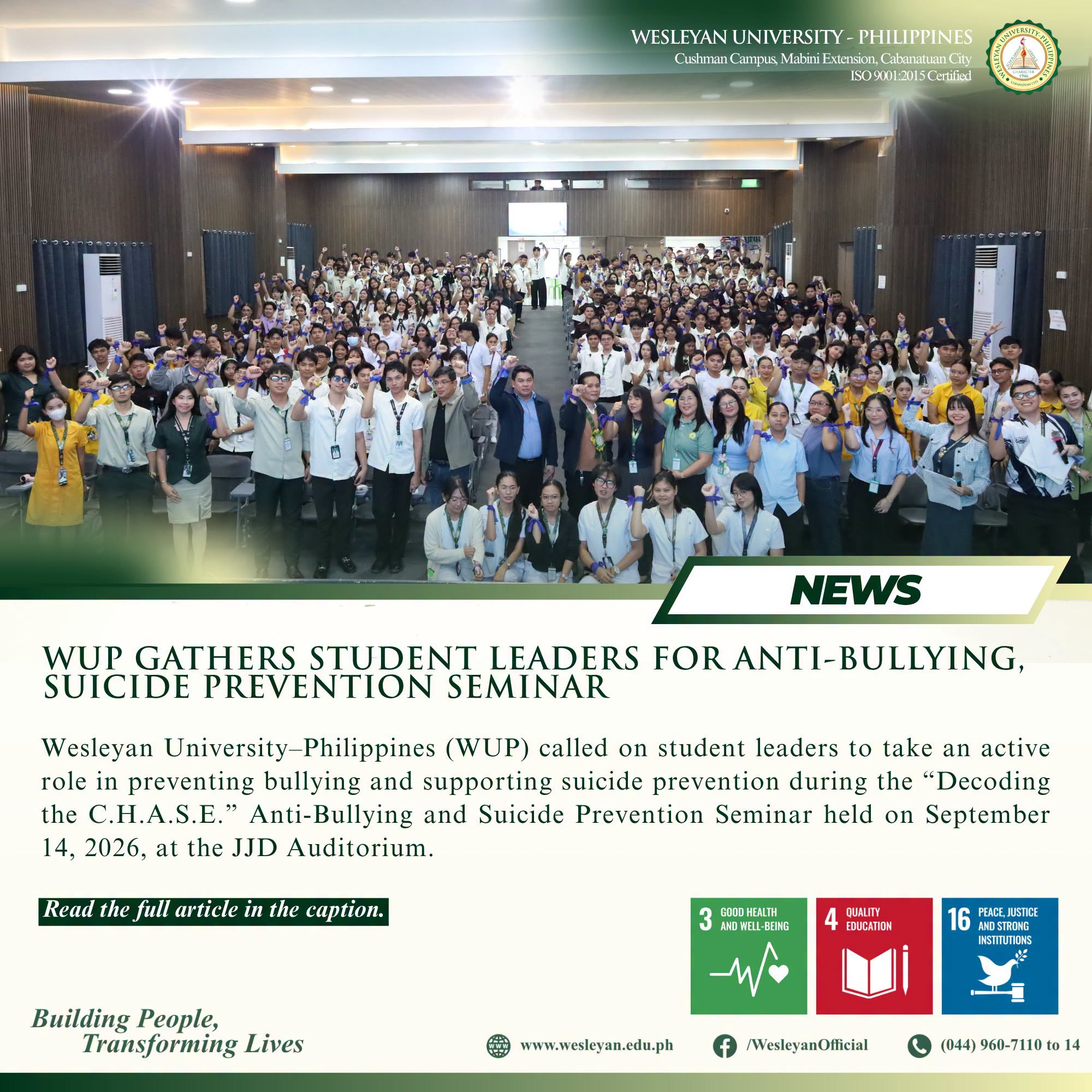
 Wesleyan University–Philippines (WUP) called on student leaders to take an active role in preventing bullying and supporting suicide prevention during the “Decoding the C.H.A.S.E.” Anti-Bullying and Suicide Prevention Seminar held on September 14, 2026, at the JJD Auditorium.Carrying the theme “Championing Hope, Awareness, Safety, and Empathy—Preventing Suicide and Ending Bullying, One Student at a Time,” the half-day seminar brought together college council governors, council officers, the Supreme Student Council, and members of the university community to strengthen awareness and encourage collective action for student well-being.
In his opening remarks, Vice President for Academic Affairs Wilfredo C. Ramos emphasized that bullying and suicide prevention cannot be left to a single office or individual. He described the initiative as a shared responsibility centered on caring for the dignity and well-being of every student.
Ramos connected the C.H.A.S.E. campaign to WUP’s core values of Compassion, Harmony, Accountability, Spirituality, and Excellence, urging the university community to look beyond formal policies and programs and become more intentional in supporting one another.
“Bullying is not simply a student problem,” Ramos stressed, noting that educators, friends, classmates, and other members of the university community all have a role in creating spaces where students do not feel invisible, unheard, or alone.
Student leaders as frontliners
Director of the Guidance and Placement Center Henry Cocoy Nacpil placed particular emphasis on the role of student leaders, describing them as frontliners who can help their peers navigate personal and mental health challenges.
Nacpil encouraged council governors, Supreme Student Council officers, and recognized student organizations to participate in building a “bully-proof university.” He also emphasized that mental health begins with self-awareness, urging students to regularly check in with themselves, recognize their own needs, and seek help when necessary.
He further shared the University’s efforts to establish designated safe spaces within its colleges, reinforcing the goal of making students feel that they belong and that the University can serve as a second home.
For Nacpil, supporting mental health also meant creating a culture in which asking for help is accepted rather than viewed as a weakness.
Building a culture of “See. Include. Respect.”
Director of the Gender and Development Office Jaziel Naomi C. Reyes focused on the importance of inclusive and respectful communities through the framework “See. Include. Respect.”
Reyes urged students to notice when someone is struggling or being excluded, make room for different voices and experiences, and maintain respect even when disagreements arise. She emphasized that differences in background, ability, identity, personality, and opinions should never become reasons for disrespect.
She also reminded student leaders that leadership extends beyond titles and positions. Their influence, she said, could be seen in how they treat classmates, respond to bullying, listen to others, and create spaces where students can be themselves.
“Difference is never an invitation to disrespect,” Reyes emphasized, while encouraging students to speak up when someone is being hurt and to help connect those in need with appropriate support.
Prevention begins before a crisis
Chairman of the Crisis Management Committee and Officer-in-Charge of the Security Office Renato Salvador broadened the discussion to crisis prevention and preparedness.
Salvador stressed that crisis management does not begin only after an incident occurs. It could also involve recognizing possible warning signs, strengthening coordination, and ensuring that students and personnel know where to seek help.
He identified changes such as withdrawal, frequent absences, declining academic performance, isolation, and repeated experiences of bullying as signs that may warrant attention and support.
He also encouraged students to build a culture where simple interactions can make a difference, calling on the University community to become a “community of hi and hello.”
Salvador also underscored that security goes beyond enforcing rules and responding to incidents. He pointed out that it ultimately involves protecting people and creating an environment where students feel safe to report concerns and ask for help.
Turning awareness into action
Resource speaker Benny Samson Soliman, Ph.D., an Associate Professor V and Director of the Student Placement Office at Tarlac Agricultural University, and a Registered Psychologist and Guidance Counselor specializing in clinical and counseling psychology, provided students with practical discussions on bullying and suicide prevention, challenging common misconceptions while emphasizing early recognition and appropriate responses.
Soliman began by asking participants to check in with themselves, emphasizing that caring for others also requires attention to one’s own well-being.
“We cannot give what we do not have,” he told the participants, underscoring the importance of taking care of one’s own mental health before attempting to support others.
He also encouraged students to pause and ask themselves a simple but meaningful question: “Self, how are you?”
Through an interactive self-check, Soliman reminded students that feelings such as tiredness, hunger, sleepiness, confusion, or happiness are valid and should not simply be ignored.
The resource speaker then turned the discussion toward bullying, explaining that it can take several forms, including physical, verbal, social, cyber, and discriminatory bullying.
He emphasized that bullying could happen in school, in the community, or online and could affect anyone.
“No one deserves to be bullied,” Soliman said, reminding participants that being bullied is not the victim’s fault.
He also discussed the emotional, cognitive, behavioral, and social effects of bullying, including fear, shame, sadness, self-blame, isolation, absenteeism, declining academic performance, and loss of trust.
For students experiencing bullying, Soliman advised them to stay calm, seek support, document incidents when safe, stay with trusted people, and report the behavior to appropriate university personnel.
He particularly warned students against responding to bullying by hurting themselves, stressing that victims should not blame themselves or keep their experiences to themselves.
Challenging suicide myths
Soliman also used an interactive myth-and-fact activity to address common misconceptions surrounding suicide.
Among the misconceptions discussed was the belief that most suicides happen suddenly without warning.
“It’s not true that there is no warning at all. There may be signs. Sometimes it is when they jokingly said ‘Malay n’yo bukas, wala na ako’. That can be the sign.”
Soliman identified this as a myth, emphasizing the importance of recognizing warning signs rather than assuming that suicidal behavior always happens without indications.
He likewise challenged the idea that someone experiencing suicidal thoughts is necessarily determined to die, explaining that people may experience ambivalence and may instead be seeking an end to overwhelming emotional pain.
Another misconception he addressed was that a person who becomes suicidal will always remain suicidal. Soliman emphasized that suicidal thoughts are not necessarily permanent, reinforcing the importance of timely intervention and support.
The discussion shifted the focus from simply recognizing problems to knowing how to respond. Soliman encouraged students to speak up, reach out, and connect struggling peers with trusted adults or appropriate support services.
Students commit to looking out for one another
The message was reinforced by the collective commitment of the college council governors, college council officers, and supreme student council president, who recognized that student leaders are students themselves and experience many of the same pressures as their peers.
The student representatives acknowledged the challenges of balancing academics, work, responsibilities, finances, and family life, noting that people may be facing struggles that are not immediately visible to others.
They urged their fellow students to choose kindness and recognize their shared responsibility to help shape the University community.
“We may have different struggles, but we share the same space, the same community, and in one way or another, the responsibility of looking after each other,” the student leaders said.
Representatives from the colleges also collectively pledged to stand with WUP and the Guidance and Placement Center in promoting a safe, caring, and supportive environment, while opposing bullying, supporting suicide prevention, and promoting the mental well-being of every student.
The seminar ultimately positioned student safety and mental well-being not as the responsibility of one office, but as a continuing commitment shared across the university.
Through C.H.A.S.E.—Championing Hope, Awareness, Safety, and Empathy— WUP called on its community to turn awareness into action: to notice those who may be struggling, include those who feel left out, respect differences, speak up against harm, and ensure that no student has to face difficult moments alone.
Article by Emily Agumbay (PIO)
Photos by John Carlo Dauz (PIO)