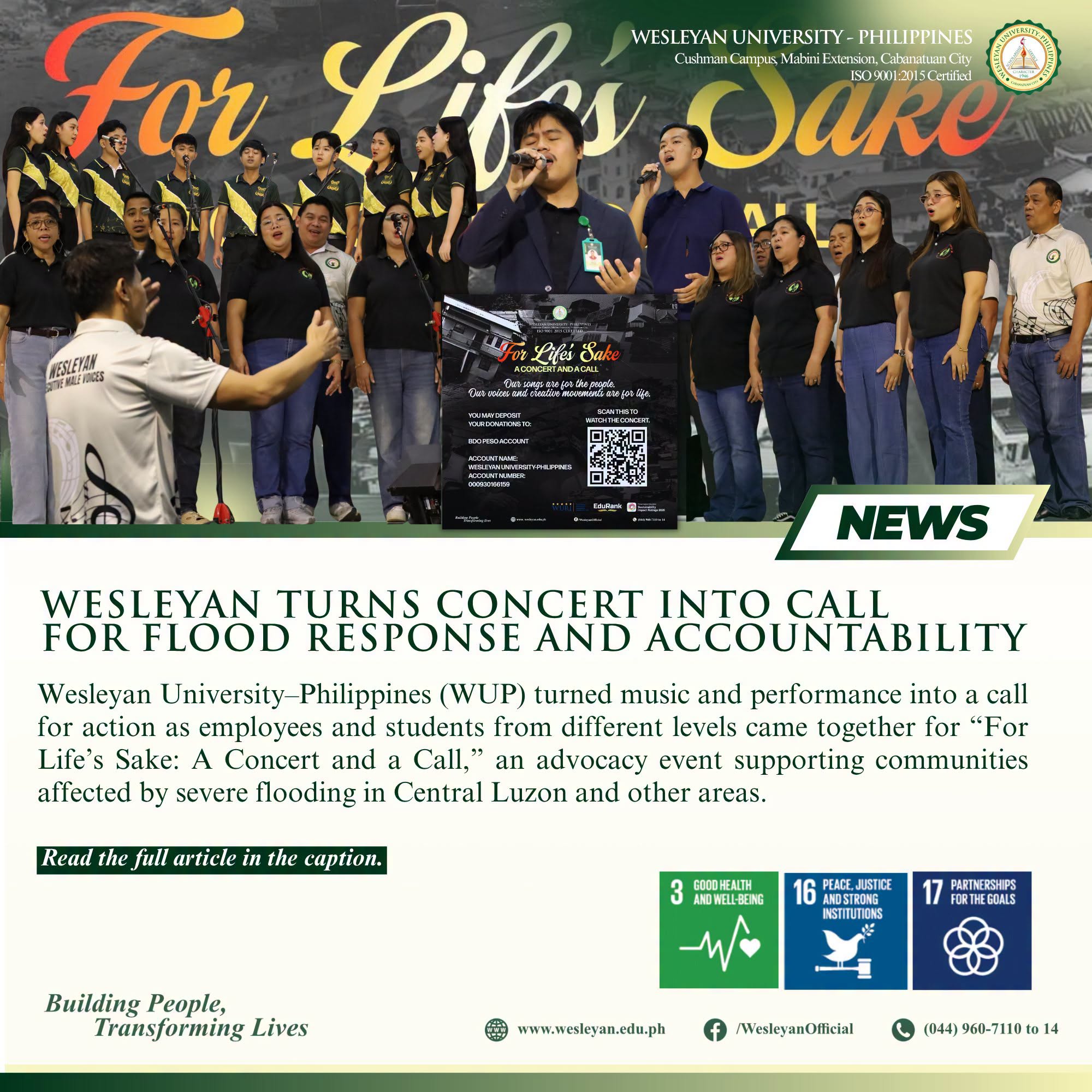
 Wesleyan University–Philippines (WUP) turned music and performance into a call for action as employees and students from different levels came together for “For Life’s Sake: A Concert and a Call,” an advocacy event supporting communities affected by severe flooding in Central Luzon and other areas.
Held in response to the flooding in provinces including Pampanga, Bulacan, Tarlac, Zambales, and nearby areas caused by the monsoon rains and recent typhoons, the video-recorded concert brought together the University community through songs, dances, and messages of solidarity.
WUP Vice President Gladys P. Maguiduyos said the concert marks the University’s third “For Life’s Sake” concert for a cause, describing the initiative as part of the institution’s culture of responding to communities in times of crisis.
“After learning about what is happening in Pampanga, Tarlac, Bulacan and other nearby provinces, I asked the President to organize and mobilize people to do a concert so that we can reach as many people as we could,” Maguiduyos said.
She emphasized that the initiative goes beyond the distribution of relief goods, calling attention to the need for government action to address the recurring flooding problem.
“We are calling the attention of the government, calling for accountability, calling on people who would really address this perennial problem of flooding,” she added.
For WUP President Irineo Alvaro Jr., the advocacy reflected the Wesleyan tradition of connecting faith with service to society.
“Every time na may mangyayaring sakuna, we quickly address it in our own way, in our own capacity, in our own resources,” Alvaro said.
He explained that the initiative draws from the teachings of John Wesley, particularly the principle of social holiness, which emphasizes that faith should be reflected through service and engagement with society.
The performances also carried a message beyond entertainment, with Alvaro describing the songs as expressions of grief, hope, and solidarity with those affected by the floods.
“Maririnig mo rin yung mga salita na naghihimok ng pagkilos sa kinauukulan, hindi lang yung hahayaan na natin dahil resilient tayo,” he said.
Alvaro further described “For Life’s Sake” as a call for accountability among those entrusted with public responsibility.
“Ang ‘For Life’s Sake’ ay isang paraan upang tawagin natin ang mga nasa gobyerno, mga nanunungkulan na maging accountable sa kanilang ginagawa sa kanilang tungkulin,” he said.
The concert echoed the University’s “For Life’s Sake: A Statement of Conscience and a Call to Action,” which calls for more than immediate disaster relief. The statement penned by Mangiduyos and read by Sam Gabriel R. Pabilona, a student leader and reigning Mister Wesleyan, urged stronger flood-control systems, properly maintained waterways, responsible land-use planning, environmental protection, resilient infrastructure, early-warning systems, humane evacuation facilities, and accountable use of public funds.
It also cautions against treating Filipino resilience as a substitute for effective systems that protect communities from recurring disasters.
Through the participation of students and university leaders, the concert transformed the Wesleyan community’s concern into a collective call for solidarity, responsibility, and action —underscoring that protecting life requires not only responding to disaster but also addressing the conditions that allow communities to remain vulnerable.
The recorded “For Life’s Sake” concert was made available through WUP’s official YouTube channel on September 17, 2026 (https://youtu.be/Aoko4gFDjrg?si=C3dw18ixJCSg6DIT) for those who wish to watch and learn more about the advocacy. Those who want to extend financial assistance to communities affected by the floods could also send donations through the designated account:
BDO PESO ACCOUNT
ACCOUNT NAME: WESLEYAN UNIVERSITY-PHILIPPINES
ACCOUNT NUMBER: 00930166159
The initiatives underscored the University’s continuing commitment to putting faith into action and standing with communities in times of crisis.
Article by Emily G. Agumbay (PIO)
Photos by John Carlo S. Dauz (PIO)