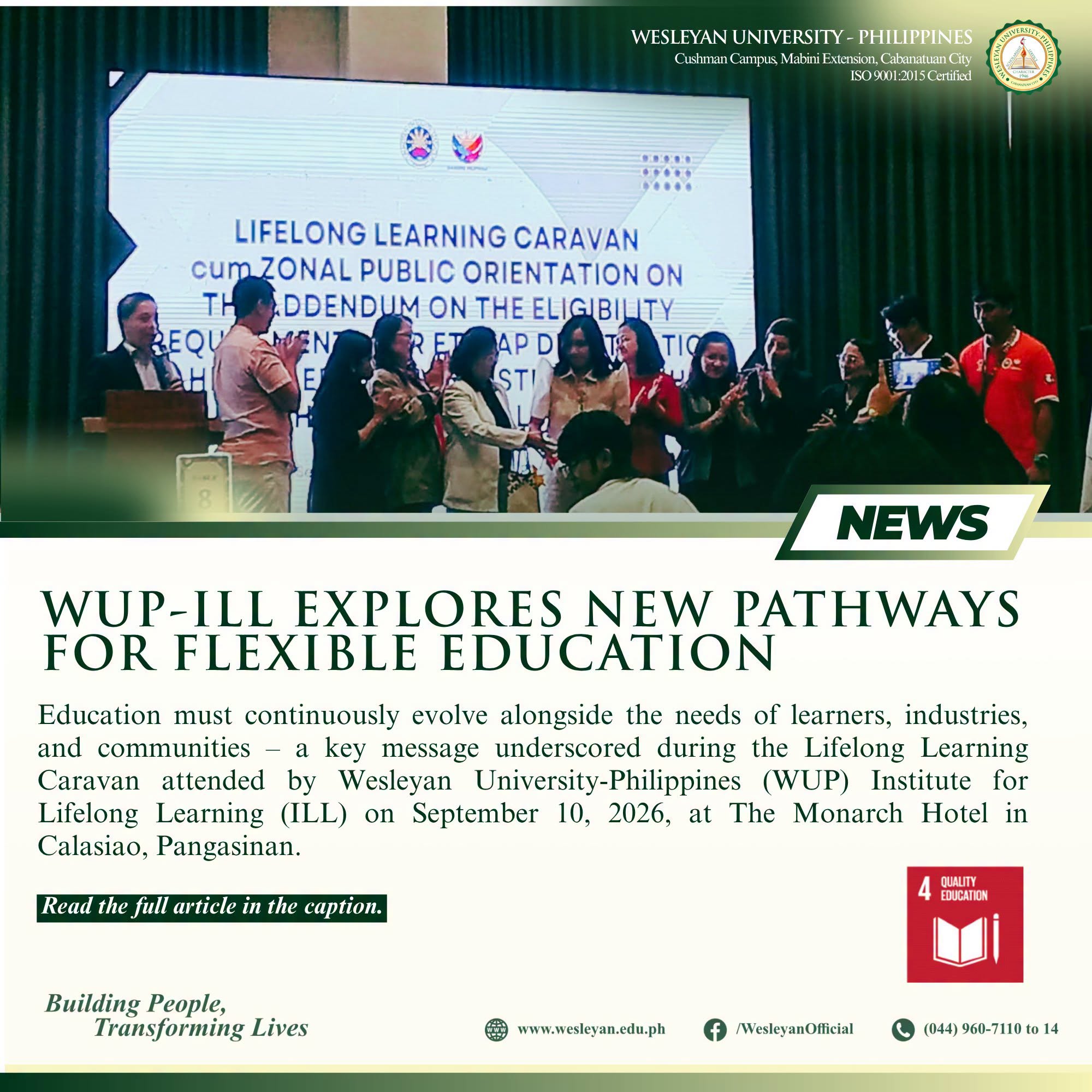
 Education must continuously evolve alongside the needs of learners, industries, and communities – a key message underscored during the Lifelong Learning Caravan attended by Wesleyan University-Philippines (WUP) Institute for Lifelong Learning (ILL) on September 10, 2026, at The Monarch Hotel in Calasiao, Pangasinan.The caravan cum Zonal Public Orientation on the Addendum to the Eligibility Requirements for the ETEEAP Deputization of Higher Education Institutions (HEIs) for the North and Central Luzon Cluster brought together representatives from government agencies and higher education institutions to discuss policies and initiatives supporting lifelong learning, workforce development, and flexible higher education delivery.
The first plenary session highlighted the connection between education, labor, and industry in preparing Filipinos for changing workplace demands. Representatives from the Department of Labor and Employment (DOLE), Department of Social Welfare and Development (DSWD), Overseas Workers Welfare Administration (OWWA), and Department of Trade and Industry (DTI) discussed employment pathways, lifelong learning opportunities, educational assistance for Overseas Filipino Workers (OFWs), and micro-credentials anchored on the Philippine Skills Framework.
The discussion emphasized that learning should extend beyond traditional classroom settings and should remain responsive to the evolving needs of workers, industries, and communities.
Meanwhile, the second plenary session examined the growing role of the Expanded Tertiary Education Equivalency and Accreditation Program (ETEEAP), Micro-Credentials, and Open Distance and e-Learning (ODeL) in expanding access to higher education.
Throughout the breakout sessions, participating institutions also shared their experiences and practices on program implementation, quality assurance, and strategies for delivering accessible and flexible lifelong learning opportunities.
For WUP-ILL, the caravan served as an avenue to identify possible directions for strengthening the University’s lifelong learning agenda. Among the recommendations were a comprehensive institutional self-assessment for ETEEAP, enhancement for Micro-Credentials curricula, and exploration of ODeL initiatives supported by Continuous Quality Improvement (CQI) mechanisms.
These initiatives would require strategic planning, responsive institutional policies, adequate resources, and sustained leadership commitment as WUP continues to align its lifelong learning programs with CHED standards.
Through the ILL, WUP sought to translate the insights gained from the caravan into initiatives that would expand learning opportunities beyond traditional education and respond to the changing needs of learners, workers, and communities.
Article by Luel T. Mateo (ILL) and Emily G. Agumbay (PIO)
Photos courtesy of the Institute of Lifelong Learning