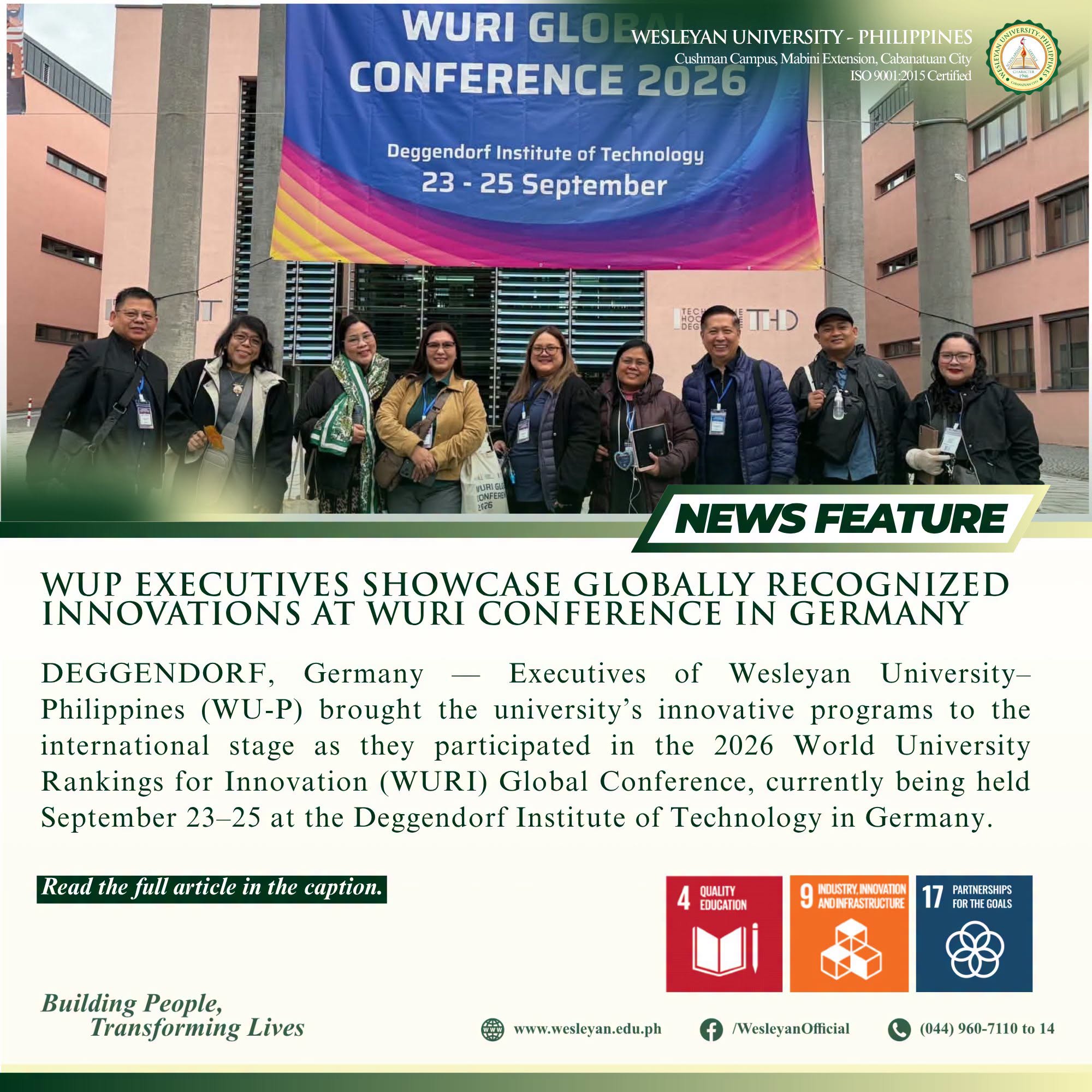
 DEGGENDORF, Germany — Executives of Wesleyan University–Philippines (WU-P) brought the university’s innovative programs to the international stage as they participated in the 2026 World University Rankings for Innovation (WURI) Global Conference, currently being held September 23–25 at the Deggendorf Institute of Technology in Germany.
The conference gathered university leaders, educators, researchers, and innovators from around the world to exchange ideas and showcase initiatives that translate academic knowledge into practical solutions for society. It reflects WURI’s emphasis on innovation, implementability, and impact, recognizing universities not merely for traditional academic achievements but for their ability to respond creatively to real-world challenges.
For the Wesleyan delegation, the gathering provided an opportunity to present the university’s globally recognized innovations while discovering how institutions across different countries are transforming ideas into meaningful and sustainable action.
Eleven WUP Innovations Earn Global Recognition
WU-P’s participation followed the announcement of its 11 recognized innovative programs in the 2026 WURI Global Rankings, which highlight university initiatives demonstrating innovation and contributions to society.
The university’s recognized entries span research ethics, environmental sustainability, leadership development, artificial intelligence, cybersecurity, renewable energy, student learning, community welfare, and entrepreneurship.
The recognized programs and their corresponding WURI ranking entries are:
WURI Entry and Recognized Innovative Program
A6_045 – Guardians of Integrity: The University Research Ethics Committee (UREC)
A7_096 – Plastic Use Reduction and Waste Management
B2_091 – Project L.A.K.A.D. (Leadership Advancement, Knowledge and Development)
B3_094 – Project P.R.A.I.S.E. (Performance Review using Artificial Intelligence for Strategy Evaluation)
B5_099 – Sustaining Futures, Igniting Enterprise: The Wesleyan Spirit
B6_032 – Project C.L.O.S.E.D. (Cybersecurity Laboratory using Open-Source Equipment for Defense)
B7_085 – The BAC Advantage: Turning Ethical Procurement into Financial Efficiency
C1_017 – Project AQUASUN: A Solar-Powered Desalination Unit Incorporating Reverse Osmosis and Multi-Filter System
C2_054 – HAVENLINK: A Comprehensive System for Home for Girls Residential Treatment Facility
C4_064 – Project A.I.S.L.E. (Artificial Intelligence for Student Learning Empowerment)
C8_046 – E-HUB (Electronic Hub Start-Up Company from CECT, WU-P)
These initiatives reflect the breadth of innovation taking place within the university, from strengthening institutional governance and ethical practices to developing technological solutions and addressing the needs of communities.
Beyond the recognition, the conference reinforced a shared realization among WU-P executives: innovation becomes meaningful when it moves beyond institutional accomplishments and creates lasting improvements in people’s lives.
Innovation Begins with Real Needs
For Eufemia Ayro, Director of Community Outreach, who attended the WURI Conference for the first time, the experience provided a fresh perspective on the university’s existing programs and their potential to contribute to the global conversation on innovation.
“Successful and sustainable WURI programs are designed in response to the needs of the institution, the community, the country, and the global community. Their success requires collective effort, careful planning, strong collaboration, and a shared commitment to transforming innovative ideas into meaningful and lasting actions,” Ayro said.
“More importantly, we must learn to ‘walk the talk’ by putting our plans and commitments into practice to ensure that these programs remain relevant, impactful, and sustainable.”
As she listened to presentations from other universities, Ayro realized that many of WU-P’s ongoing initiatives already possess the qualities of innovations worthy of international recognition.
“This is my first time attending the WURI Conference, and the experience has given me a deeper appreciation of what we are already doing at Wesleyan University–Philippines. As I listened to the presentations and learned from the innovative practices of other institutions, I realized that there are also many programs, initiatives, and accomplishments at WU-P that we can proudly showcase to the world.”
“We already have many good practices; what we need is to recognize their value, strengthen them through collaboration, document their impact, and continue improving them so that they can become sustainable innovations worthy of global recognition,” she added.
Ayro’s reflection was echoed by Vice President for Academic Affairs Wilfredo Ramos, who emphasized that innovation is neither confined by an institution’s resources nor measured by the scale of its projects.
“Innovation is the name of the game. We should never feel limited by where we come from or by what we have. True innovation is measured by the positive change it creates in people’s lives. We simply need to start with what we have, make the most of it, and let its impact create a ripple of transformation,” Ramos said.
The same understanding resonated with Ryan John De Lara, Dean of the College of Engineering and Computer Technology, who observed that meaningful innovation often begins with seemingly modest initiatives.
“WURI 2026 has made us realize that innovation need not be a grand feat—it lies in the simplest initiatives and creative actions that bring significant impact to their beneficiaries. This affirms that WU-P’s innovation initiatives have substantial effects that profoundly shape our community and the rest of the world,” De Lara said.
Together, their reflections underscored a central message of the conference: the significance of innovation rests not simply in its originality but in its capacity to address actual needs and create positive change.
Transforming Education Through Purposeful Innovation
As universities increasingly explore the possibilities of artificial intelligence and emerging technologies, the WURI conference also provided an opportunity to examine how innovation can strengthen the teaching and learning process without diminishing the human dimensions of education.
Juanito Leabres Jr., Director of the Office of Instruction and Lifelong Learning, emphasized the importance of preserving teachers’ roles while harnessing technology to enrich educational experiences.
“AI in instruction is not about choosing between technology and teachers, but empowering teachers to use technology with purpose, wisdom, and heart. This forum reinforced my conviction that meaningful experiences and shared ideas can become a harvest of creative possibilities for the future of education,” Leabres said.
His reflection highlighted the need for educational innovation to remain grounded in thoughtful teaching, human relationships, and purposeful learning.
For Jaziel Naomi Reyes, Director of Gender and Development, the international gathering also revealed that universities, despite differences in culture, context, and resources, share a fundamental commitment to making education more meaningful.
“WURI presentations amazed me because, despite our differences, we share a common purpose, that is, to make education more responsive, relevant, inclusive, and meaningful. As a presenter, I felt proud to share what we are doing in our institution and realized that our work also has a place in the global conversation on educational innovation,” Reyes said.
Her experience affirmed that innovation is not the exclusive domain of large or heavily resourced institutions. Universities serving their own communities can contribute valuable insights and practices to the international educational community.
When Innovation Touches Lives
While technology and academic transformation formed important dimensions of the conference, WU-P executives repeatedly returned to the human purpose of innovation.
Carissa Juliana Balaria, Dean of the College of Nursing, reflected on how a single idea, when developed in response to the needs of others, can create changes far greater than its apparent simplicity.
“We often talk about innovation in terms of advanced systems, but true innovation is really about the community you belong to. All it takes is a single idea to spark something new and make a tangible difference in someone’s life. That is what makes WURI so powerful: it takes an idea that feels simple, yet creates an impact that means a whole lot to someone else,” Balaria said.
Her observation found a parallel in the reflection of Kay Ann Tongol, Dean of the College of Allied Medical Sciences, who emphasized that recognition should follow meaningful service rather than become the ultimate objective of institutional innovation.
“Putting our university on the map is not the ultimate goal—prestige and accolades will follow when we genuinely live out our Vision, Mission, and core values through meaningful service. Our research, innovations, and academic achievements should never sleep on shelves; they must reach the community, address real needs, and create lasting impact in the lives of the people we serve,” Tongol said.
For both academic leaders, the value of innovation is ultimately demonstrated in the lives it touches, the communities it strengthens, and the opportunities it creates for those whom the university is called to serve.
Recognition as a Responsibility to Serve
As the Wesleyan delegation engaged with innovative institutions from around the world, the conference also opened opportunities to reflect on internationalization as a means of strengthening institutional responsibility.
Rio Anne Dizon, Director of Internationalization and Linkages, emphasized that university rankings must not become ends in themselves but should inspire institutions to deepen their commitment to society.
“University ranking should not merely be a measure of prestige or cyclical institutional achievements. It should be a reminder of our responsibility to create meaningful change. True excellence is demonstrated when our innovations move beyond the campus and intentionally respond to the needs of our immediate communities,” Dizon said.
“When innovation is guided by integrity and moral purpose, recognition becomes more than an achievement; it becomes an accountability badge signifying our commitment to serve and transform.”
Her reflection brought together the recurring themes expressed by the Wesleyan executives: collaboration, integrity, purposeful education, community responsiveness, and sustainable transformation.
The recognition of WU-P’s 11 innovative programs illustrates how the university’s work in governance, instruction, research, technology, sustainability, and community engagement can contribute to wider conversations on the future of higher education.
More importantly, the conference served as a reminder that the university’s vision and mission find their fullest expression not in the number of recognitions received, but in the continued translation of knowledge, values, and innovation into service.
From Deggendorf, Germany, the Wesleyan delegation carries home more than international recognition. It brings renewed perspectives, emerging possibilities for collaboration, and a strengthened commitment to ensuring that innovations developed within the university continue to respond to the needs of the institution, the country, and the global community.
For Wesleyan University–Philippines, the enduring significance of innovation lies not merely in being recognized by the world, but in making a meaningful difference in the world it seeks to serve.
Article by Gladys P Mangiduyos
Photos courtesy of WUP WURI Global Conference 2026 Team