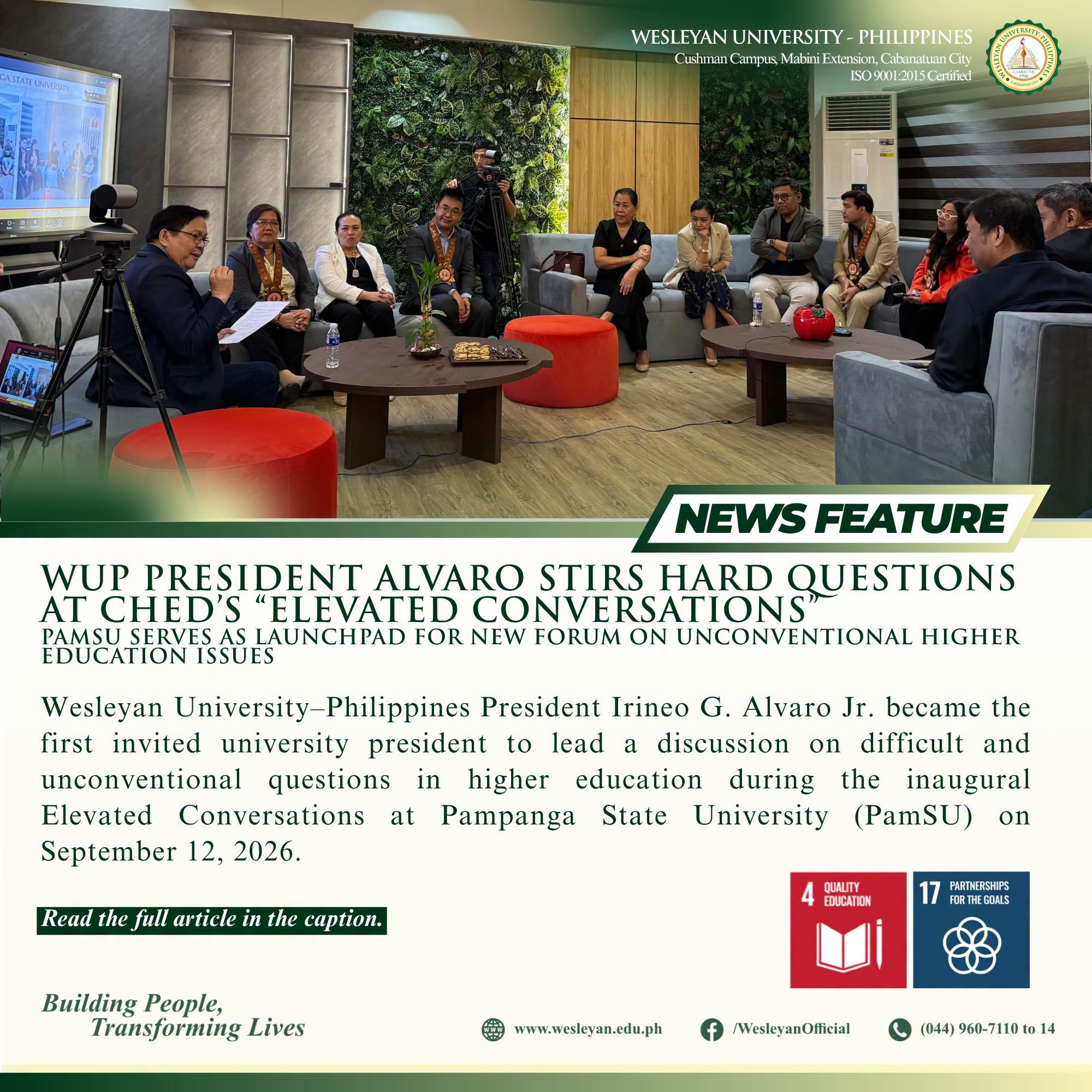
 PamSU serves as launchpad for new forum on unconventional higher education issues
Wesleyan University–Philippines President Irineo G. Alvaro Jr. became the first invited university president to lead a discussion on difficult and unconventional questions in higher education during the inaugural Elevated Conversations at Pampanga State University (PamSU) on September 12, 2026.
Led by the Commission on Higher Education, with PamSU serving as the initiative’s SUC lead, Elevated Conversations was designed to create space for deeper dialogue on issues that may be complex, unconventional, or difficult to address in traditional educational leadership.
The initiative was envisioned as an “intellectual laboratory” where higher education leaders can question assumptions, exchange perspectives, and engage on issues beyond technical compliance. Its project framework identified SUC presidents as the first invited participants, with succeeding conversations to involve selected participants from graduate schools.
For its inaugural conversation, Alvaro facilitated “Sustaining the Unsustainable?”, which examined two major promises of RA 10931 and RA 12325: access and quality.
The conversation on access examined the continuing financial demands of universal higher education, including the costs of students, faculty, facilities, laboratories, technology, and student services, against finite public resources. It also raised questions about whether expanding access without sufficient attention to institutional capacity and labor-market demand could result in more degree holders without enough meaningful opportunities.
It also asked whether access should necessarily mean a four-year degree for everyone, or a meaningful educational pathway for everyone, including technical, vocational and shorter-cycle programs.
On quality, the discussion moved beyond compliance and considered three dimensions: design, conformance, and performance. It asked whether quality should be measured not only by adherence to standards but also by the public value generated through employment, social mobility, research, innovation, and community transformation.
Other issues raised during the conversation included the duplication of academic programs, the expansion of graduate education, the continuing role of liberal education in the age of artificial intelligence, and the need for multiple learning pathways through microcredentials, stackable credentials, and recognition of prior learning. The discussion also questioned when institutions should create new degrees—and when they should begin obsoleting programs that may no longer be relevant to the future.
The discussion likewise challenged conventional ideas of employability, emphasizing that quality education should not direct students only toward traditional professional careers but should also recognize the dignity of technical work, skilled trades, agriculture, caregiving, entrepreneurship, and other socially necessary forms of work.
Alvaro’s selection as the first speaker reflected his roles in both university leadership and the wider higher education sector, currently serving as President of the Association of Christian Schools, Colleges, and Universities (ACSCU) and Chairman of the Coordinating Council of Private Educational Associations (COCOPEA).
The format of Elevated Conversations was deliberately built around dialogue. Inspired by the Greek agora, the facilitator would open the discussion, while participants were expected to question, respond, and disagree. The project also treated governance as extending beyond executive leadership to areas such as human resources, legal interpretation, academic culture, and institutional management.
The September 12 session did not attempt to resolve all the questions it raised. Instead, it opened a larger conversation about what the higher education system must change if it is to sustain its promises of access and quality.
At the heart of the discussion was a tension: access without quality may expand credentials without sufficiently expanding opportunity, while quality without access may produce excellent education that remains socially exclusive.
That tension might well define the purpose of Elevated Conversations itself: to create a place where higher education can talk about the questions that are hardest to answer.
Article by Emmanuel John R. Pangan (OP)
Photos courtesy of the Office of the President