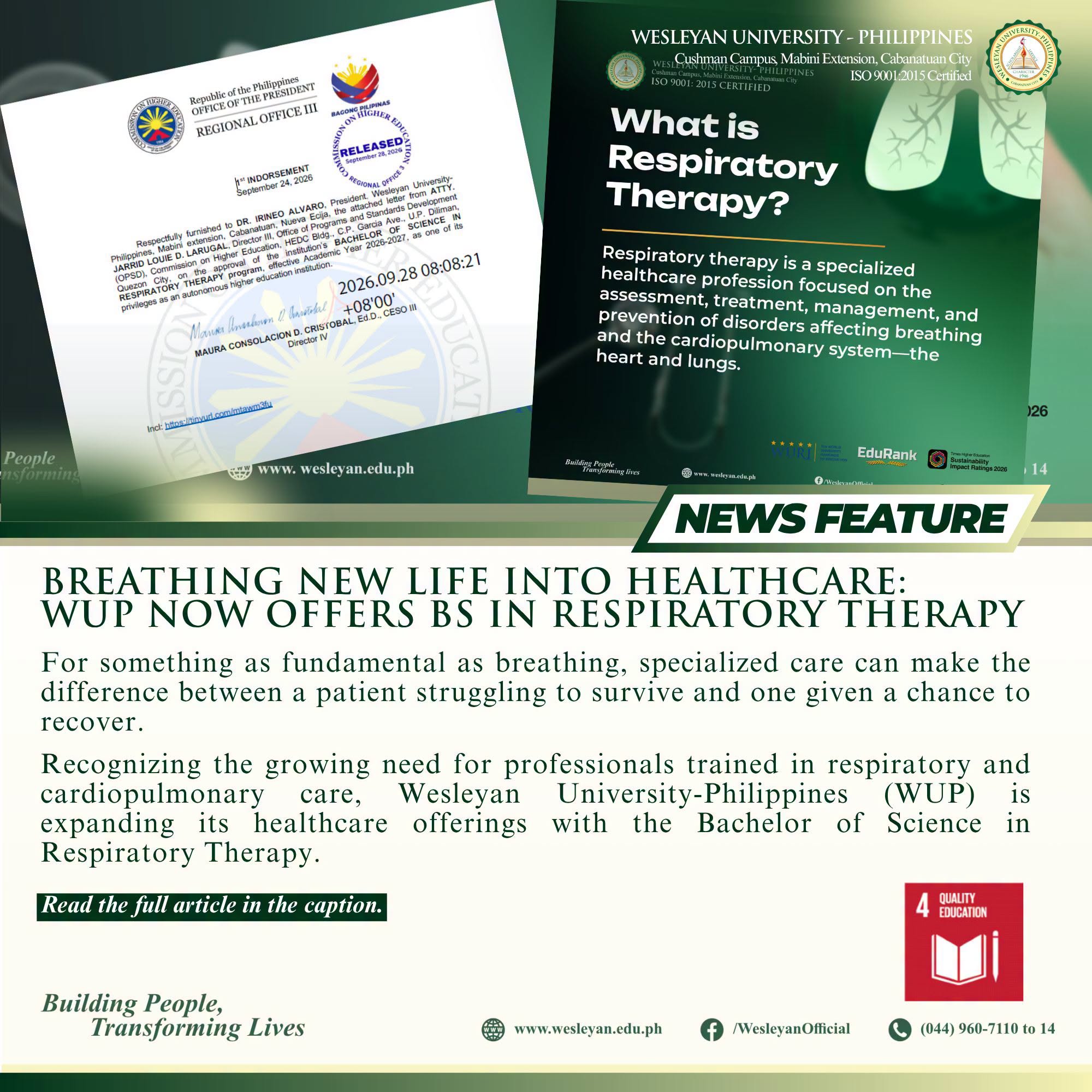
 For something as fundamental as breathing, specialized care can make the difference between a patient struggling to survive and one given a chance to recover.
Recognizing the growing need for professionals trained in respiratory and cardiopulmonary care, Wesleyan University-Philippines (WUP) is expanding its healthcare offerings with the Bachelor of Science in Respiratory Therapy.
For Kay Ann J. Tongol, RPh., MSc., Dean of the College of Allied Medical Sciences (CAMS), the new program is more than an expansion of WUP’s academic offerings. It responds to a shortage of respiratory therapists in the country and offers an opportunity to strengthen the healthcare workforce in the community.
Respiratory therapy is a specialized healthcare profession focused on the assessment, treatment, management, and prevention of disorders affecting breathing and the cardiopulmonary system – the heart and lungs.
Respiratory therapists work closely with patients experiencing problems involving their lungs, airways, breathing, or oxygenation. Their work may include assessing a patient’s respiratory status, administering oxygen and inhaled medications, managing mechanical ventilators and other respiratory-support equipment, providing airway management, and assisting in respiratory-care planning.
Answering a Growing Need
For Tongol, the vision behind WUP’s new program began with a pressing reality: the Philippines has only around 9,000 respiratory therapy professionals, while only 26 universities and colleges in the country offer the program.
The shortage became particularly evident during the COVID-19 pandemic, when respiratory care became a critical component of patient treatment and highlighted the importance of professionals trained to manage patients with breathing and pulmonary conditions.
“Since konti lang ang mga respiratory therapists, 9,000 lang,” Tongol said, emphasizing the need to prepare more professionals who can respond to the respiratory healthcare needs of Filipinos.
The need is not limited to major healthcare centers. Tongol noted that tertiary hospitals such as St. Luke’s Medical Center and The Medical City have respiratory therapists as part of their healthcare teams, while hospitals in the province may have difficulty finding qualified professionals.
As a result, some respiratory therapists are recruited from other provinces.
Through the new program, WUP hopes to help address this gap by producing graduates who can eventually serve healthcare institutions in Nueva Ecija and other communities.
Completing the Healthcare Roster
For WUP, establishing BS Respiratory Therapy is also part of a larger effort to build a more comprehensive healthcare education community.
The University already offers programs in nursing, pharmacy, medical technology, radiologic technology, and physical therapy, alongside its Doctor of Medicine program. The addition of Respiratory Therapy would bring another specialized healthcare profession into the WUP’s academic roster.
“We need to complete the roster,” Tongol said.
Unlike healthcare roles that may overlap in patient care, respiratory therapists are specifically trained to handle the assessment and management of breathing and cardiopulmonary conditions. Their responsibilities can extend from monitoring oxygenation and conducting or assisting with diagnostic tests to providing noninvasive ventilation, airway-clearance procedures, and other forms of respiratory support.
They can also educate patients and their families about respiratory diseases, medications, equipment, and self-management – making their role important not only inside hospitals but also in helping patients manage their conditions beyond clinical settings.
Learning Beyond the Classroom
WUP’s future respiratory therapy students will be introduced to both the clinical and community dimensions of the profession.
Tongol said students will have opportunities to participate in community outreach activities and respiratory health campaigns as well as seminars, workshops, and research forums.
Clinical training will form another important part of their preparation. Students are expected to undergo internships in tertiary hospitals where respiratory therapists are actively practicing, allowing them to experience patient care and work alongside other members of the healthcare team.
These experiences are intended to prepare students for a profession that requires both technical competence and the ability to work closely with patients, families, and other healthcare professionals.
The university also sees the program as opening opportunities beyond the Philippines.
As WUP continues to pursue a global direction, graduates may pursue careers as registered respiratory therapists, pulmonary function technologists, clinical educators, healthcare managers in respiratory care departments, or researchers and innovators in respiratory sciences. The profession may also provide opportunities for international practice in countries that recognize respiratory therapy.
Training Professionals Who Care
Beyond technical competence, Tongol hopes the program will produce respiratory therapists who embody the values of the University.
The goal, she said, is to develop professionals committed to delivering excellent healthcare while remaining grounded in compassion and accountability.
“From our values, they are compassionate, and we will have excellent graduates at Wesleyan University-Philippines,” Tongol said.
With BS Respiratory Therapy, WUP is expanding its contribution to healthcare education while responding to a gap in the country’s healthcare workforce.
For the University, every future respiratory therapist represents another professional prepared to provide specialized care when patients need it most.
In a field centered on something as fundamental as breathing, WUP hopes its graduates will bring not only clinical expertise, but also the compassion and commitment needed to help every patient breathe a little easier.
Article by Emily G. Agumbay (PIO)