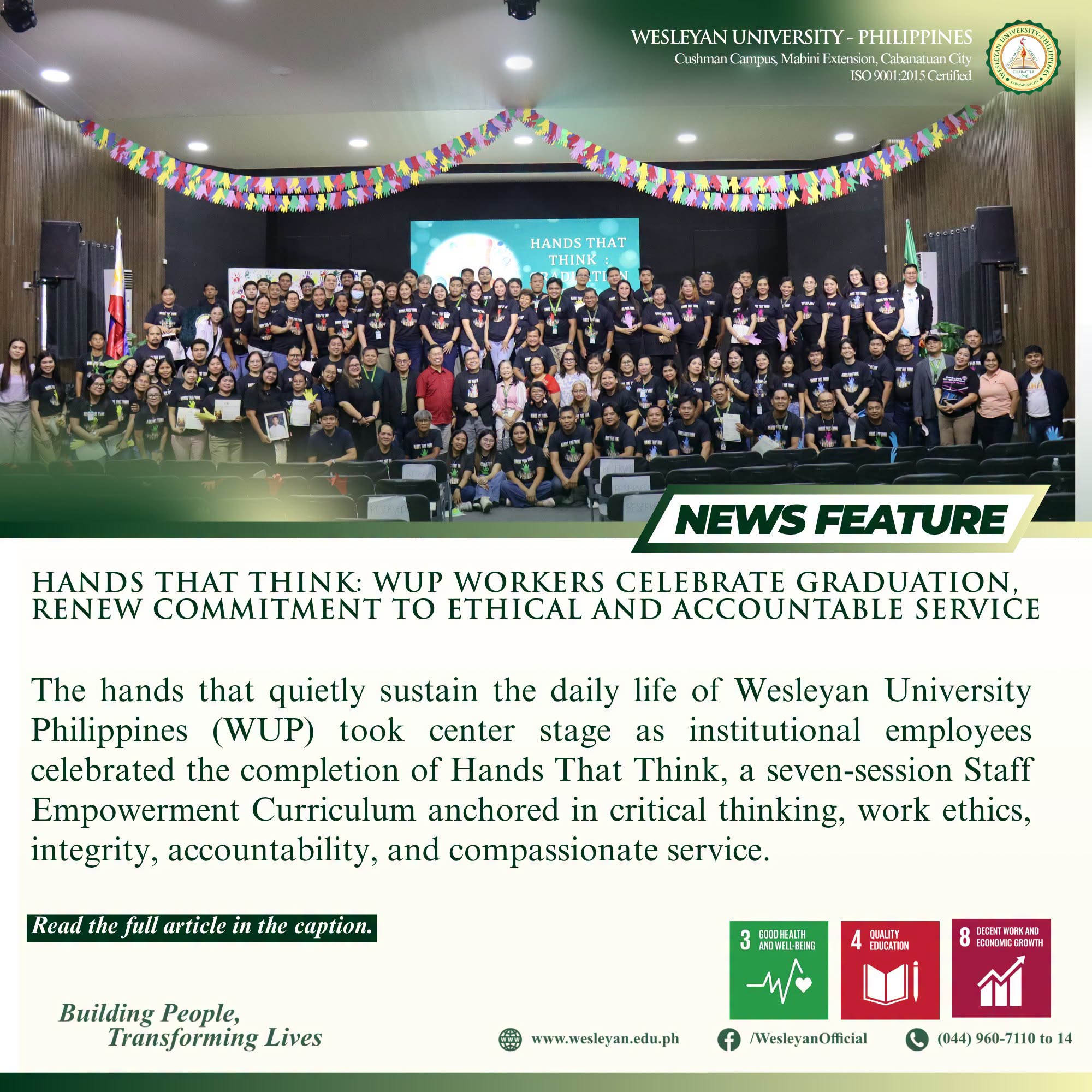
 The hands that quietly sustain the daily life of Wesleyan University-Philippines (WUP) took center stage as institutional employees celebrated the completion of Hands That Think, a seven-session Staff Empowerment Curriculum anchored in critical thinking, work ethics, integrity, accountability, and compassionate service.
For four months, employees from various departments devoted seven Thursdays to 90-minute learning sessions, balancing their demanding responsibilities with opportunities to reflect, question, collaborate, and rediscover the dignity and significance of their work.
Led by Dr. Gladys P. Mangiduyos, Vice President for Administration and Planning, the curriculum introduced critical thinking as a practical discipline through the Pause, Ask, Choose framework, encouraging employees to examine situations carefully, verify information, and make responsible decisions instead of reacting impulsively.
The graduation, attended by University President Dr. Irineo G. Alvaro Jr., Dr. Abraham Pascua, deans, department heads, and staff members, became more than a celebration of completed sessions. It was a collective affirmation that the people who sustain the institution can also strengthen its culture, governance, and ethical practices.
Five Voices, Five Reflections on Transformation
Five employee representatives shared distinct reflections on the program, showing how critical thinking began to reshape their understanding of responsibility, teamwork, personal growth, and institutional service.
Edmond Concepcion, representing the Blue Team, described the curriculum as an unprecedented opportunity for employees whose contributions often take place beyond the public eye.
“Nabigyan kami ng oras, ang katulad ko naming maliliit na empleyado,” Concepcion expressed, recognizing the University’s decision to invest in the personal and professional development of its workforce.
Beyond acquiring new knowledge, the speaker emphasized the importance of pausing before reacting, asking questions before making judgments, and transforming routine tasks into a collective practice of accountability. The sessions also created meaningful connections among personnel from different departments who previously encountered one another mainly during daily time-in and time-out.
For Aren Jay Garcia of the Green Team, one of the most profound realizations was that professional excellence should never come at the expense of personal well-being and meaningful relationships.
“Ang tunay na katatagan ay ang pagkilala sa iyong mga limitasyon, ang pagkakaroon ng lakas ng loob na humingi ng tulong,” Garcia reflected.
He challenged the conventional notion that strength means silently enduring exhaustion or confronting every difficulty alone. Instead, he underscored the importance of emotional resilience, respectful relationships, and maintaining a healthy balance between professional responsibilities and family life.
Gerriedel G. Sison of the Violet Team offered a compelling metaphor for the central philosophy of the curriculum: hands must become instruments of thoughtful action rather than merely perform assigned tasks.
“Ang kamay na nag-iisip ay nangangahulugang ang ating mga kamay ay hindi lamang tagasunod ng utak; sila ang tagasalin ng ating mga pangarap patungo sa realidad,” Sison declared.
For Sison, knowledge and principles become meaningful only when translated into action. The challenge, therefore, is not simply to become knowledgeable in theory but to demonstrate wisdom through everyday work.
Meanwhile, Malou Sarmiento of the Yellow team, whose reflection focused on practical workplace applications, emphasized how critical thinking strengthens institutional safety, responsibility, communication, and disaster preparedness.
“Walang maliit na trabaho. Ang bawat manggagawa ay kailangang bigyan ng dignidad at parehong karapatan,” the representative affirmed.
Drawing from the learning activities, Sarmiento highlighted how employees could apply critical thinking to identify workplace hazards, protect university resources, coordinate responsibilities, conserve water and electricity, and prepare for potential El Niño-related challenges.
The reflection emphasized that responsible service requires not merely completing assigned duties but also anticipating risks, examining reliable information, and protecting the welfare of students, employees, patients, and visitors.
Rogelio Gamata, representing the Red Team, celebrated the friendships and solidarity developed throughout the program.
“Hindi kailangang pare-pareho tayo upang magkaisa. Ang mahalaga ay marunong tayong makinig, gumalang, umunawa, at umalalay sa isa’t isa,” the representative shared.
Under the declaration “Iisang Puso, Iisang Layunin, Sama-samang Maglilingkod!, the Red Team emphasized that an institution’s strength lies not only in individual competence but also in its people’s willingness to support and uplift one another.
The representative further described workplace safety as an expression of care, reminding colleagues that every employee has loved ones waiting for their safe return home.
Beyond Certificates: A Commitment to Institutional Transformation
The seven-session curriculum explored the dignity of work, workplace safety and orderliness, time and responsibility management, communication and teamwork, service excellence, problem-solving and decision-making, and integrity and personal growth.
Interactive exercises, collaborative activities, workplace scenarios, and the Pause, Ask, Choose approach made critical thinking accessible to employees across different levels of educational preparation and professional responsibility.
The program also demonstrated that staff development need not be confined to technical competence. It can nurture dignity, confidence, solidarity, stewardship, and a deeper understanding of how ordinary tasks shape others’ lives.
As graduates renewed their commitment to work ethics, accountability, and discipline, the occasion underscored a powerful institutional realization: “the transformation of a university does not depend solely on those who formulate policies, but equally on the hands that faithfully carry them out.”
A President’s call to turn learning into service
In his inspirational statement, University President Dr. Irineo G. Alvaro Jr. reminded the graduates that the university’s continued progress depends on the people whose everyday work keeps the institution running, even when their contributions go unnoticed.
He emphasised that no task is insignificant when it serves a greater purpose, pointing to the employees who prepare classrooms, ensure transportation safety, maintain university facilities, and carry out responsibilities that allow the academic community to function.
“There is no small work when it serves a greater purpose,” Alvaro stressed, underscoring the dignity of every employee’s contribution to the university’s mission.
He also reinforces the principle of the curriculum – Pause, Ask, Choose – as a practical guide for responsible decision making assumptions, and choose the appropriate course of action after careful consideration.
For Alvaro, critical thinking is not reserved for academics or those in leadership positions. It is equally essential to maintenance personnel, drivers, and employees across all departments, whose everyday decisions can prevent accidents, address workplace concerns, and protect the welfare of the university community.
He further connected ethical work with personal faith, emphasizing that integrity is demonstrated not only through major decisions but also through how employees use their time, treat their colleagues, and fulfill their responsibilities when no one appears to be watching.
Recognizing the effort required to complete seven Thursday sessions alongside regular work responsibilities, Alvaro congratulated the graduates while reminding them that receiving certificates is not the ultimate measure of the program’s success.
“The real success will be known when we are able to bring to life what we have learned during these sessions,” he emphasized, challenging employees to reflect on how the experience would change their attitudes, decisions, and approach to service.
He concluded with a call for the workforce to continue serving with dignity, working with excellence, and choosing integrity, reminding the graduates that every action carries the potential to benefit others and contribute to the university’s mission.
Hands That Think now moves beyond the classroom into the daily responsibilities of the workforce, where its true impact will be measured not by certificates received but by decisions made, responsibilities fulfilled, people protected, and lives touched.
For WUP, Hands That Think do more than accomplish work. They help shape the character of the institution they serve.
Article by OVPAP & PIO
Photo Courtesy of Office of the Vice President for Administration and Planning