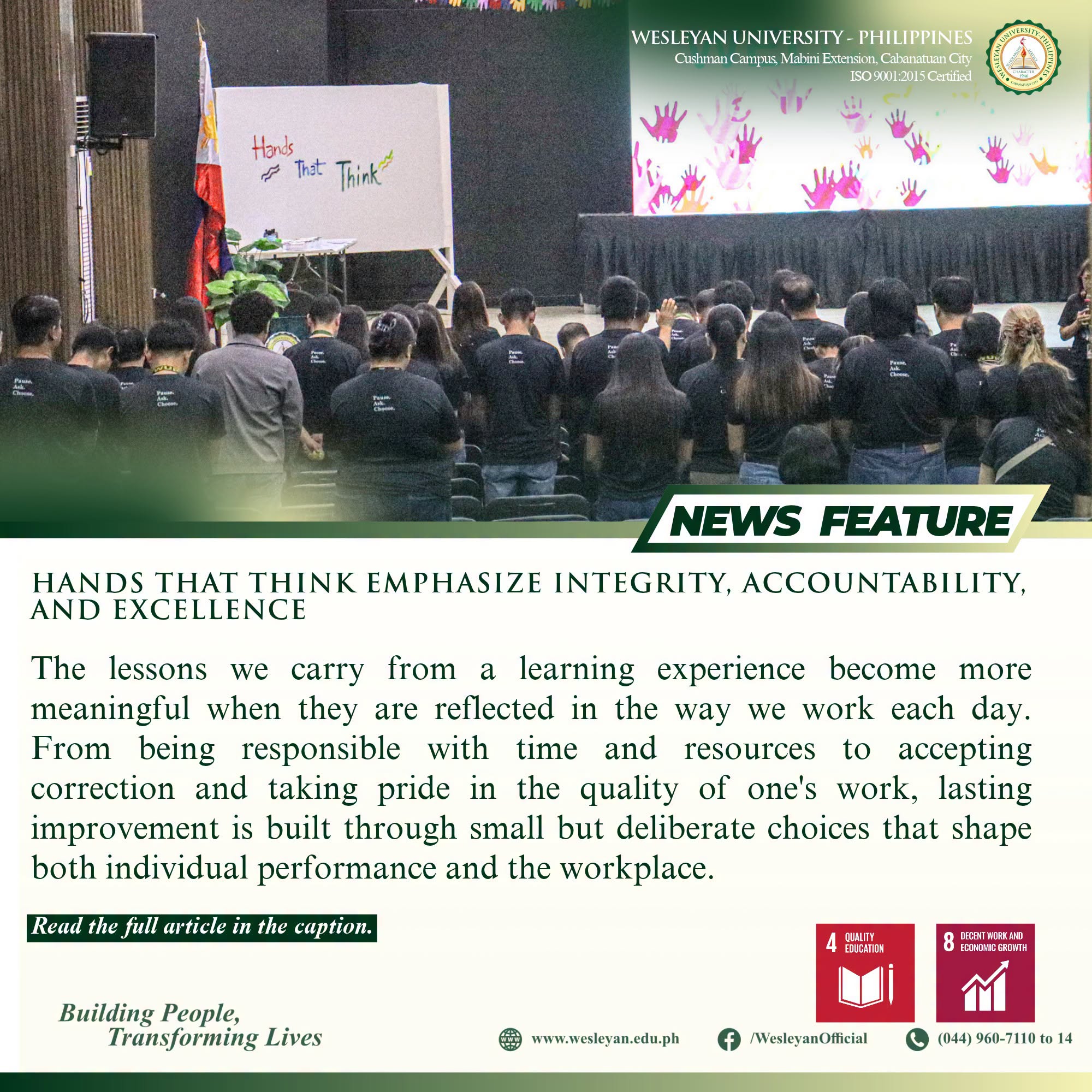
 The lessons we carry from a learning experience become more meaningful when they are reflected in the way we work each day. From being responsible with time and resources to accepting correction and taking pride in the quality of one’s work, lasting improvement is built through small but deliberate choices that shape both individual performance and the workplace.
On October 22, 2026, the Jose Justina, Dominga (JJD) Garcia Auditorium served as the venue for the seventh session of Hands That Think. Led by Gladys P. Mangiduyos, Vice President for Administration and Planning, the session encouraged members of the Wesleyan University-Philippines community to reflect on their work habits and recognize how discipline, integrity, accountability, responsible stewardship, and excellence can be practiced through everyday responsibilities.
Mangiduyos emphasized the importance of making wise and responsible use of the resources entrusted to employees. Rather than understanding frugality simply as spending less, she underscored a more purposeful meaning:
“Frugal is the wise use of every resource.”
Through practical examples involving office supplies, university-provided materials, water, fuel, and transportation, Mangiduyos reminded participants that institutional resources must be treated with care. Even ordinary decisions, such as avoiding unnecessary consumption, conserving available resources, and using
University transportation efficiently, can contribute to more responsible use of what the institution provides.
The discussion then turned to the proper use of University resources and adherence to established procedures. Mangiduyos reminded participants of the importance of following procedures found in the University’s manuals and policies. These guidelines help employees carry out their responsibilities with consistency, discipline, and accountability.
Equally important was the willingness to accept correction. Mangiduyos shared how accountability can be strengthened when colleagues respectfully remind one another whenever something needs attention or improvement. She illustrated how members of a team can look out for one another and help ensure that responsibilities are completed properly and on time.
This becomes particularly important because individual responsibilities do not exist in isolation. A delayed document, unfinished task, or overlooked process may eventually affect another employee or office. Accountability therefore requires employees to recognize that the way they handle their responsibilities can also influence the work of others.
Building on this idea, Mangiduyos encouraged participants to develop pride in excellent work. Excellence, she emphasized, is more than accomplishing a task simply to finish it. It involves giving one’s best effort and carrying out each responsibility with care and a genuine sense of accountability.
She reinforced this reflection with the reminder:
“There will never be another now. Make the most of today.”
The message encouraged participants to recognize the value of the present and make the most of every opportunity to perform their responsibilities well. Time that has passed cannot be recovered, making each task an opportunity to work with greater purpose, discipline, and commitment.
Mangiduyos likewise invited participants to examine their personal work habits by considering what they could still improve and how such changes could affect their team, responsibilities, and personal growth. Through this reflection, participants were encouraged to recognize that improvement does not always require major changes. It can begin with everyday habits involving time management, discipline, honesty, accountability, and consideration for others.
Toward the end of the session, participants took part in a pledge activity, placing their painted handprints as a symbol of their commitment. Mangiduyos described the activity as a reminder to practice good time management, discipline, integrity, accountability, care for others, and proper care of University property.
More than a symbolic activity, the handprints served as a reminder that the values discussed during the session are meant to be practiced beyond the auditorium. Through conscious decisions, responsible work habits, openness to correction, and proper use of resources, participants were encouraged to translate reflection into consistent action in the workplace.
Session 7 reinforced that excellence is reflected not only in major accomplishments, but also in the small choices employees make every day. By carrying out responsibilities with integrity, accountability, discipline, and care, each member of the University community can help build a workplace culture grounded in responsible service and excellence.
Article by Jhoanna D. Andres (PIO)
Photo Courtesy of Office of the Vice President for Administration and Planning