 What if a university were built not primarily around what students need to know, but around how they need to think?
That question seems to lie at the heart of Minerva University, an institution that has challenged many of the conventions traditionally associated with higher education and, in doing so, has earned recognition as the No. 1 Most Innovative University in the World for five consecutive years, from 2022 to 2026, according to the World University Rankings for Innovation (WURI).
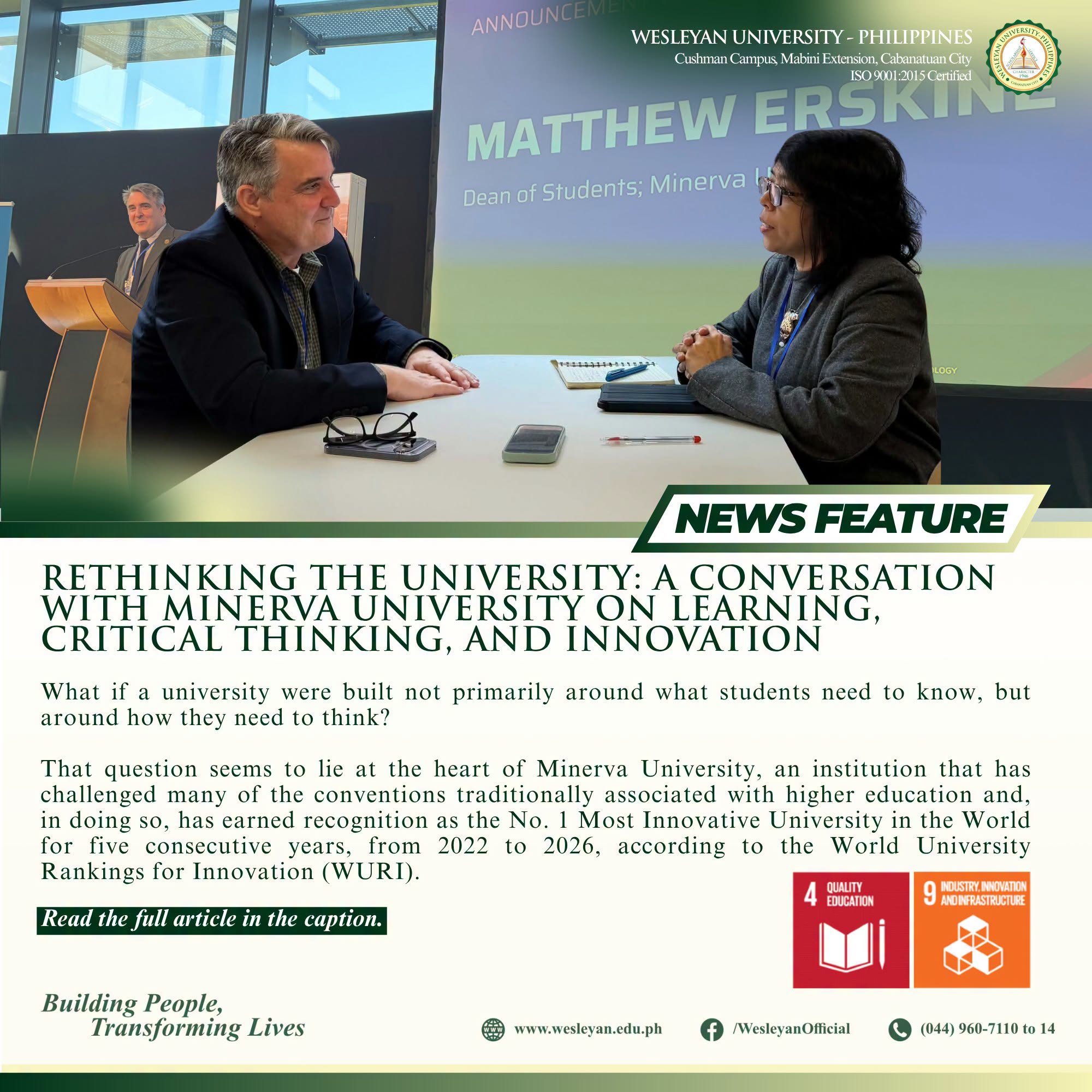
The author had the chance to interview the most innovative university, represented by its Dean of Students, Matthew Erskine. For the author, a critical thinking advocate, an interview with Matthew Erskine of Minerva University became more than a conversation about an unconventional university. It became an opportunity to look more closely at what education might become when an institution is willing to question some of its oldest assumptions.
Founded in 2012, Minerva University is an independent, nonprofit institution headquartered in San Francisco, California, and accredited by the WASC Senior College and University Commission. It welcomed its first undergraduate class in 2014. Today, its learners represent more than 100 countries, reflecting a deliberate commitment to making education international not merely in composition, but in experience and perspective.
A University Built Differently
Minerva’s most distinctive characteristic is that it did not begin by asking how to improve the conventional university.
It asked how higher education might be redesigned from the ground up.
There are no traditional lecture halls at the center of the Minerva experience. Instead, students participate in small, highly interactive seminars in which they are expected to analyze, question, debate, explain, defend, and apply ideas. Learning is active rather than passive, with faculty guiding students through structured discussions and providing continuous feedback.
Its curriculum is grounded in the science of learning, interdisciplinary education, and the repeated application of knowledge to unfamiliar situations. Rather than treating education principally as the accumulation of information, Minerva places emphasis on transferable abilities—skills students can carry from one problem, discipline, or cultural environment to another.
At the foundation are four capacities: critical thinking, creative thinking, effective communication, and effective interaction. These are developed through what Minerva calls Habits of Mind and Foundational Concepts—ways of thinking that students repeatedly practice until they become tools they can consciously apply to real-world problems.
This gives Minerva a distinctive personality: the university does not simply teach students what to think about; it deliberately teaches them how to think.
Critical thinking, therefore, is not confined to one course or introduced as an occasional academic exercise. It is embedded across the curriculum. Students are expected to examine assumptions, evaluate evidence, recognize patterns, consider alternative explanations, make reasoned judgments, and transfer what they have learned from one context to another.
In an age when information is instantly available—and increasingly generated or mediated by artificial intelligence—this philosophy becomes particularly relevant. Minerva argues that the enduring value of education lies less in memorizing information and increasingly in developing judgment: knowing what questions to ask, determining whether information is credible, and deciding how knowledge should be used.
The World as a Classroom
Minerva also challenges the idea that learning must remain within the physical boundaries of a conventional campus.
Erskine said that students are scattered to see the world, do contextualization, immersion, and embark on deep integration of learning.
“Its undergraduate model incorporates global immersion, allowing students to live and learn in different cities and cultural environments. Past and current locations have included San Francisco, Berlin, Buenos Aires, Hyderabad, Seoul, Taipei and Tokyo. The cities themselves become extensions of the classroom, where students encounter different communities, institutions, cultures and real-world problems.”
“There is a long period of curriculum development,” said Erskine.
Project-based and experiential learning further connects academic ideas with actual human concerns. Students work on problems in collaboration with organizations and communities, requiring them to move beyond knowing concepts toward applying them.
Global education at Minerva is not simply about travelling. It is about learning to see a problem through multiple cultural lenses and recognizing that solutions that make sense in one environment may need to be questioned, adapted, or completely reconsidered in another.
Innovation With Purpose
The conversation with Matthew also brought attention to another principle behind Minerva’s identity: innovation should never become innovation merely for novelty’s sake.
The institution’s philosophy suggests that educational innovation must ultimately respond to people, problems, and a rapidly changing world.
Minerva describes its mission as educating aspiring leaders, problem-solvers, and entrepreneurs through an interdisciplinary, student-centered, and global academic journey, toward the larger vision of helping create a safe, sustainable, and just future.
This explains why Minerva’s recognition under WURI is particularly significant. Its five-year run at the top—from 2022 through 2026—is not a general ranking of all universities on every conventional measure, but specifically a recognition of innovation in higher education. In 2026, the WURI field included institutions such as Arizona State University, the University of Pennsylvania, MIT, Stanford, Caltech, and École 42.
The message found resonance with Wesleyan University-Philippines, which came to this year’s international gathering carrying its own growing portfolio of innovation. Eleven WUP innovative programs were acknowledged this year, reflecting initiatives developed across the University in response to institutional, community, and societal needs.
Among these efforts is Wesleyan’s growing emphasis on critical thinking; not only as an academic competency, but as a practice that can shape how students, faculty, and staff engage information, make decisions, and respond to everyday challenges.
Matthew affirmed how important what Wesleyan University is doing–the “Critical Thinking in an Age of Noise” initiative, which brings critical-thinking formation across academic disciplines. Launched as a university-wide convocation series, it equips students to confront misinformation, social media pressures, and the rapidly changing information environment through the practical framework of Pause. Ask. Choose. Students are encouraged to pause before reacting, ask questions that test information and assumptions, and choose on the basis of evidence and thoughtful judgment.
The same philosophy has moved beyond the classroom.
Through Hands That Think, WUP staff members are being introduced to critical thinking in the everyday realities of work—time management, communication, teamwork, accountability, service excellence, and care for people. The program demonstrates that critical thinking is not reserved for scholars or classrooms; it can shape how people perform even the most ordinary tasks with greater clarity, responsibility, and purpose.
Meanwhile, the WUP John Wesley Academy and Critical Thinking Center is bringing critical-thinking pedagogy into the formation of new faculty members, encouraging educators not merely to transmit information but to create learning environments where questioning, reasoning, reflection, and sound judgment become habits.
Wesleyan’s effort echoes a principle embedded deeply in Minerva’s educational design: critical thinking cannot remain a single subject. It must become a way of learning, working, and engaging the world.
Yet behind rankings and recognition is a more enduring question: Can a university continue changing even after it has found something that works?
Erskine’s words during the conversation offered a compelling answer:
“Never stop innovating. Never stop doing things that would mean so much to people, because it is so relevant.”
The statement captures an important dimension of innovation often forgotten in the race for new technologies and new systems. Innovation is not simply about producing something different. Its significance rests in relevance—in whether change responds to human needs and improves the way people learn, live, work, and contribute to society.
For the author, whose advocacy centers on critical thinking in an age of noise, Minerva’s educational philosophy resonates strongly with the growing challenge confronting universities everywhere: information is no longer scarce. What has become scarce is the disciplined capacity to examine it carefully.
The challenge for education, therefore, may no longer be merely to provide students with more answers.
It may be to develop people capable of asking better questions.
People who can pause before accepting information, investigate assumptions, weigh evidence, listen to perspectives different from their own, and make choices with clarity and responsibility.
Minerva’s story suggests that the university of the future may not be defined primarily by buildings, lectures, or the amount of information professors can transmit. It may increasingly be defined by what happens inside the mind of the learner—the ability to think critically, create imaginatively, communicate clearly, collaborate across differences, and turn knowledge into meaningful action.
And perhaps that is the deeper lesson behind an institution that has spent more than a decade rethinking higher education:
Innovation is never finished.
Because as societies change, technologies change and human problems become more complex, education must continue asking whether what it teaches—and how it teaches it—still matters to the lives of people.
In Erskine’s simple but compelling challenge lies a message not only for Minerva, but for universities everywhere:
Never stop innovating. And never stop making innovation relevant to people.
Article by Gladys P. Mangiduyos
Photos courtesy of Gladys P. Mangiduyos