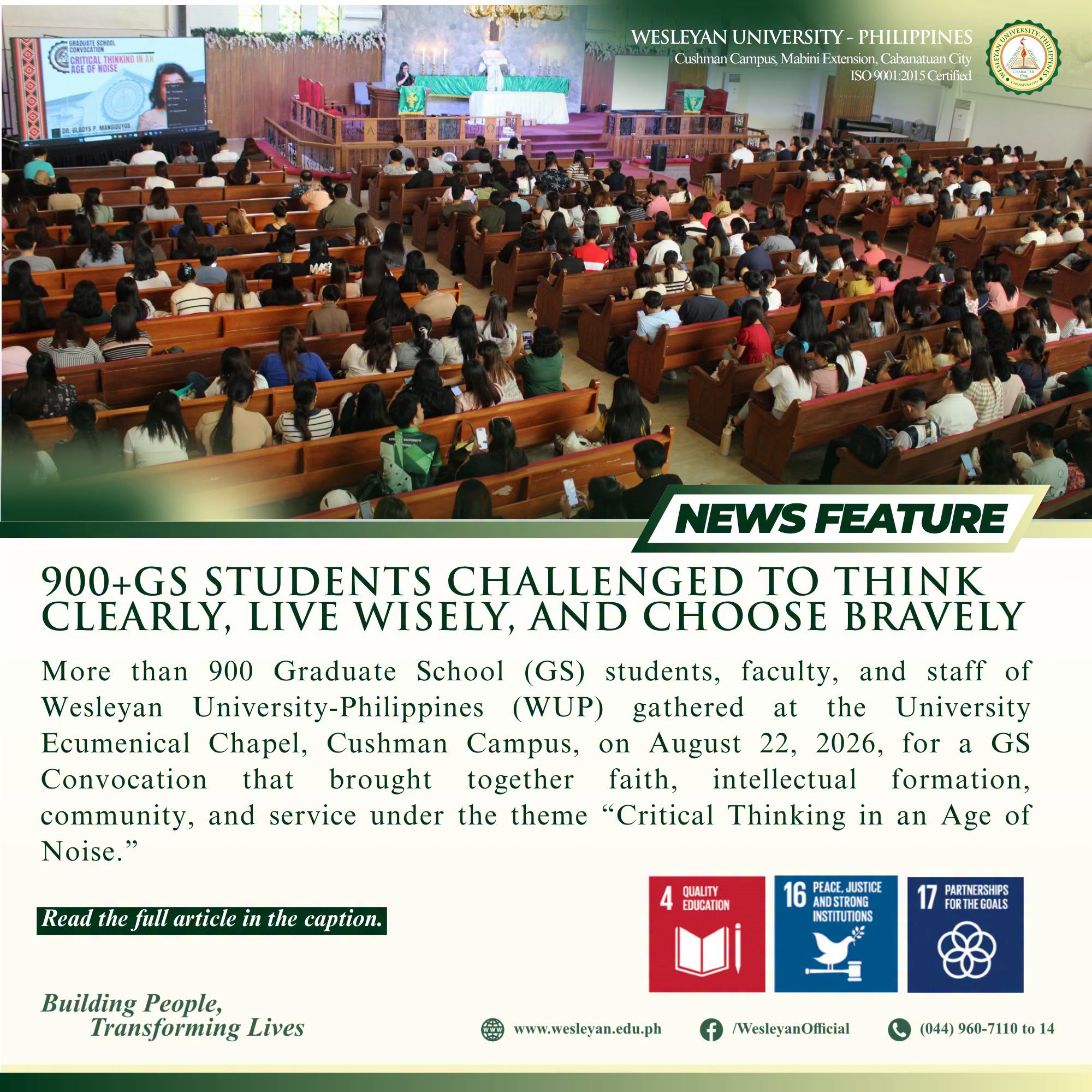
 More than 900 Graduate School (GS) students, faculty, and staff of Wesleyan University-Philippines (WUP) gathered at the University Ecumenical Chapel, Cushman Campus on August 22, 2026, for a GS Convocation that brought together faith, intellectual formation, community, and service under the theme “Critical Thinking in an Age of Noise.”
More than a traditional academic gathering, the convocation became a timely challenge to graduate scholars to ask a deeper question: In an age when machines can increasingly generate answers, how do we preserve the human capacity to think, discern, and choose?
The program opened with a devotion by Rev. Dr. Francis Fajardo, University Chaplain, who established the spiritual foundation for the gathering.
Fajardo reminded the GS community that earning a graduate degree should lead to better service to others and, ultimately, to serving God. His message challenged students to look beyond academic credentials, professional advancement, and personal achievement and recognize the greater responsibility that comes with higher education.
For graduate scholars, knowledge is not merely a privilege—it is a responsibility.
The higher we advance in learning, the greater our opportunity and commitment to use what we know for others’ good.
His devotion gave the day’s intellectual conversation a deeper purpose. Graduate education is not simply about producing people who know more. It is about forming people who can use what they know wisely, responsibly, and faithfully in the service of others.
FROM INTELLECTUAL ATROPHY TO MENTAL DEXTERITY
The intellectual centerpiece of the convocation was the lecture of Dr. Gladys P. Mangiduyos, author of Finding Clarity, who challenged the Graduate School community to confront one of the defining questions of the age of artificial intelligence:
“What happens to your mind when you no longer have to struggle to think?”
Mangiduyos warned that the greatest danger is not artificial intelligence itself, but “human intellectual atrophy.” We are no longer merely living in an information age, she explained; we are living in an age of “cognitive abundance,” where AI can rapidly generate information, explanations, arguments, summaries, opinions, and even seemingly sophisticated reasoning.
Mangiduyos emphasized the importance of anchoring the topic to the two out of five core values of WUP, which are Spirituality and Excellence, part of which is cultivating critical thinking skills. She also stressed the importance of anchoring daily self-examination (as John Wesley urged) in renewing the mind.
With the deluge of generative AI tools, Mangiduyos asked, “Do we still possess the intellectual capacity to know when an answer deserves to be accepted?”
For graduate students whose work demands research, analysis, scholarship, and professional judgment, the implications are profound.
Mangiduyos identified intellectual atrophy as the gradual weakening of critical thinking, analytical, and decision-making skills. She emphasized an important distinction: AI does not automatically cause intellectual atrophy; uncritical dependence on AI can.
THE MIND MUST REMAIN IN MOTION
Against intellectual atrophy, Mangiduyos presented mental dexterity- the ability to move the mind deliberately and flexibly.
It means having the agility to respond to the noise around. Not reacting to the noise as quickly as one could, but quick to stop and figure it out.
A mentally dexterous person, she explained, does not merely know more. They think flexibly, deeply, independently, and deliberately.
PAUSE. ASK. CHOOSE.
At the heart of Mangiduyos’s lecture was the PAC Framework, a simple, practical way to practice critical thinking. She explained the framework and gave examples.
She reminded the audience that “the machine can generate instantly. You don’t have to respond instantly.” Pausing creates the cognitive space to reflect before clicking. Pausing means stopping. Asking is raising questions to gain clarity, accuracy, and precision. “After pausing and asking to gain evidence, one may choose an informed path.”
Mangiduyos emphasized, “AI can accelerate cognition, but it cannot outsource intellectual responsibility.”
THINK FIRST. THEN USE AI.
One challenge Mangiduyos offered to graduate scholars was her human-first sequence for important intellectual work,
“The message is clear: do not ask AI to think before you have thought.”
AI should not replace intellectual effort. Instead, it can become a thinking partner or a collaborator, something that helps the learner see, challenge, compare, and explore ideas after the learner has already begun the intellectual work.
For a GS community engaged in research and advanced scholarship, this distinction matters. The challenge is not to reject AI. The challenge is to use AI without surrendering the mind.
FROM WORDS TO MOVEMENT: THE GS COMMUNITY COMMITMENT DANCE
The convocation’s intellectual message became collective action through the GS Community Commitment Dance, “Pause–Ask–Choose,” led by Physical Education and Sports students and faculty.
The activity became more than a performance. It became a visible expression of community commitment.
The participants gathered not simply to listen, but to participate, to move together and embody the central message of the convocation.
The activity demonstrated that graduate education is not confined to lectures, classrooms, research papers, or dissertations. It is holistic. It engages the mind, body, values, relationships, and community.
Through the ‘commitment dance’, the Graduate School community did not merely hear Pause. Ask. Choose. They moved with it. They experienced it. They embodied it as a community.
The convocation likewise reflected the University’s commitment to education that contributes to the United Nations Sustainable Development Goals (SDGs). Its emphasis on critical thinking, lifelong learning, intellectual development, and responsible engagement with emerging technologies strongly resonated with SDG 4: Quality Education. Its focus on discernment, ethical judgment, responsible decision-making, and intellectual responsibility also contributed to the aspirations of SDG 16: Peace, Justice and Strong Institutions, particularly by developing individuals capable of making informed and responsible choices. The collective participation of students, faculty, and staff in a shared commitment also reflected the collaborative spirit of SDG 17: Partnerships for the Goals.
In this way, the convocation showed that graduate education can extend beyond academic achievement to help form healthy individuals, responsible professionals, thoughtful leaders, engaged communities, and sustainable societies.
For Wesleyan graduate scholars, that responsibility is joined by another: to use that intellectual agency in the service of others and in the service of God.
The Convocation therefore left the community with a challenge that is both intellectual and spiritual: To always pause, ask, and choose so everyone may think clearly, live wisely, and choose bravely.
Because in an age of noise, the world does not simply need people who can produce more answers. It needs people who can ask better questions, recognize truth, make responsible choices, and turn knowledge into service.
Mangiduyos powerfully concluded, “Go as far as you can see, and when you get there, you can see farther. In an age of noise, you can choose mental dexterity.”
Article by John Mark F. Bondoc
Photos courtesy of Graduate School