 “Sapagkat ang tunay na responsibilidad ay hindi lamang pagtupad sa tungkulin—ito ay pagiging isang taong mapagkakatiwalaan.”How do we transform routine daily tasks into a collective practice of accountability, critical thinking, and institutional stewardship?
This central question anchored the third session of the 7-Thursday Staff Empowerment Curriculum, held on August 13, 2026, at the Jose, Justina, Dominga (JJD) Garcia Auditorium. Building on the foundational standards of campus security and cleanliness from Session 2, this third gathering focused on personal accountability, proactive task execution, and operational prioritization.
The session opened with a compelling address on institutional stewardship by Dr. Gladys P. Mangiduyos, Vice President for Administration and Planning. She reminded participants that managing time and tasks effectively is far more than an administrative routine; it is a direct reflection of self-discipline, respect, integrity, and genuine ownership in university operations.
The “Island” Metaphor: Navigating Operational Constraints
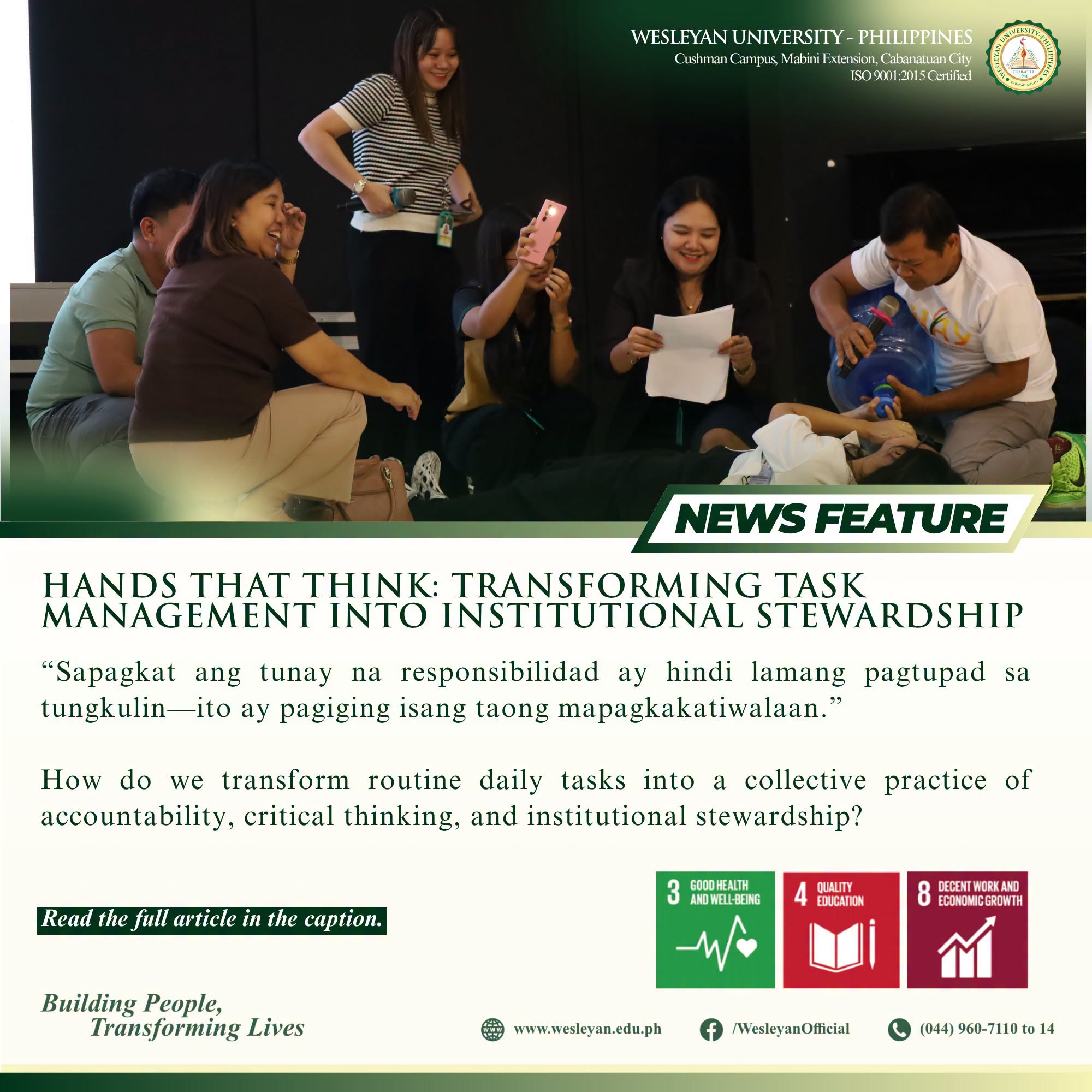
To bring these principles to life, Dr. Mangiduyos introduced an interactive simulation: “Survival on an Island with Only 17 Essentials.” Working in collaborative teams, staff were tasked with prioritizing survival items – ranging from first-aid kits and tarps to flashlights and water containers – under high-stakes uncertainty.
This kinetic exercise served as a vivid mirror for everyday campus operations, illustrating how university personnel continuously navigate real-world constraints:
• Time & Operational Deadlines
• Personnel & Team Capacity
• Financial Resources & Equipment Availability
• Information Flow & Critical Attention
The activity highlighted a core lesson: small, unaddressed details – a leaking faucet, an unlocked room, a faulty socket, a delayed report, or an unmaintained vehicle – are never isolated issues. Without proactive prioritization, minor oversights can quickly compound into major institutional disruptions.
From Passive Execution to Active Stewardship
Moving beyond passive compliance (“What should I do?”), the session challenged every employee to adopt a critical mindset: “What needs to be done first, why, and by when?”
To guide this shift, Dr. Mangiduyos outlined the Five Pillars of a Responsible Employee:
• PLAN: Establish clear action steps, strict deadlines, and target outcomes before execution.
• PRIORITIZE: Distinguish urgent, high-impact needs from routine tasks to maximize efficiency.
• PERFORM: Execute every assignment with precision, maintaining university standards from start to finish.
• COMMUNICATE: Inform supervisors and teams early when obstacles arise to maintain operational flow and avoid unexpected delays.
• FOLLOW THROUGH: Close the loop on every project by confirming completion, submitting documentation, and informing stakeholders.
The gathering also spotlighted real-world campus accountability, commending staff members who took immediate, transparent ownership of a facility concern following severe rainfall. By acknowledging the issue directly and initiating swift corrective measures, they demonstrated that true stewardship rests on honesty, swift action, and adaptability.
Pledging Action: “Hands That Think”
The session culminated in a collective pledge of commitment. Participants reaffirmed their pledge to build trust through reliable action, adaptive problem-solving, and complete ownership of their roles.
To translate these values into immediate daily practice, attendees wrote their concrete, measurable action plans on individual hand-cut-outs- symbolizing that institutional excellence and long-term progress are ultimately built by hands that truly think.
Article by Jhoanna D. Andres (PIO)
Photos by John Carlo S. Dauz (PIO)