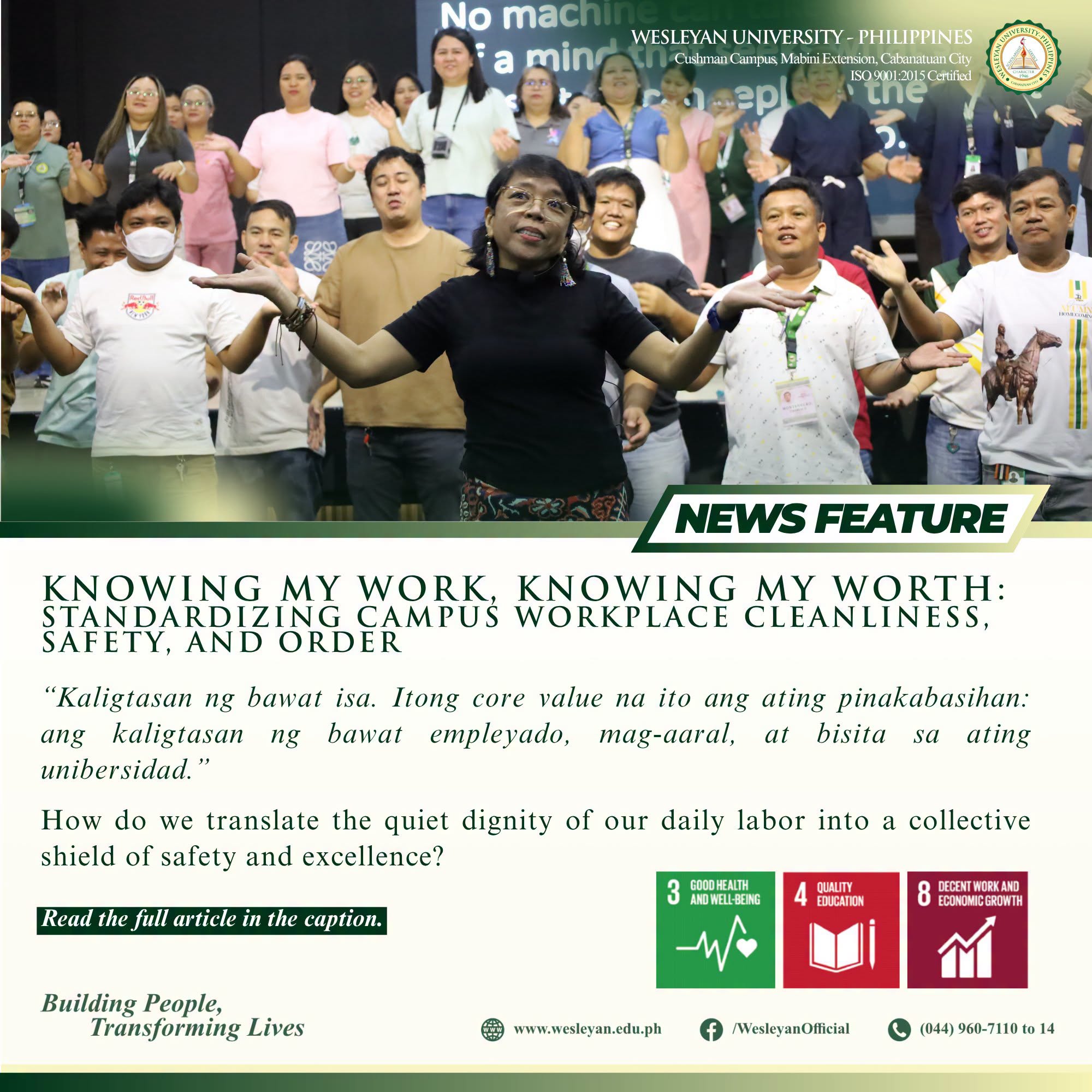
 “Kaligtasan ng bawat isa. Itong core value na ito ang ating pinakabasihan: ang kaligtasan ng bawat empleyado, mag-aaral, at bisita sa ating unibersidad.”
How do we translate the quiet dignity of our daily labor into a collective shield of safety and excellence?This was the central question that guided participants during the second session of the 7-Thursday Staff Empowerment Curriculum, held on July 16, 2026, at 9:00 a.m. in the Jose, Justina, Dominga (JJD) Garcia Auditorium.
Following the foundational reflections of the first session, this second gathering transitioned from internal purpose to practical, outward standardizing of campus security, cleanliness, and operational discipline.
The session burst into dynamic motion with an interactive group exercise designed by the speaker, Dr. Gladys P. Mangiduyos, Vice President for Administration and Planning. Standing in active coordination, participants were tasked with tossing and catching designated items using their hands. This kinetic exercise perfectly brought to life the overarching theme of “hands that think,” demonstrating that our physical actions must never be mechanical, but rather guided by real-time awareness, alertness, and critical intelligence.
Building on this physical metaphor, Dr. Mangiduyos transitioned to the core theme: “Knowing My Work, Knowing My Worth.” She explained that a deep appreciation of one’s professional value is what naturally inspires an employee to uphold a clean, safe, and orderly environment. Safety, she emphasized, is not merely an administrative protocol but a fundamental expression of care for the university community.
To build a truly resilient, safe, and orderly campus environment, Dr. Mangiduyos outlined nine interconnected principles that every employee and department must embody:
1. Establish a Comprehensive Safety & Security System – Safety cannot be treated in isolation; it must be managed as one unified, coordinated institutional system across all university offices.
2. Conduct Regular Risk Assessments – Proactively identify potential hazards in the physical workspace before they lead to incidents or disruptions.
3. Make Safety a Leadership Responsibility – Leaders and supervisors at every level must take active ownership of their team’s safety culture and operational standards.
4. Train All Personnel – Continuous education ensures every employee stays sharp, aware, and prepared for emergency protocols.
5. Use Clear Standard Operating Procedures (SOPs) – Clear, structured workflows prevent confusion, ensure quality control, and maintain daily operational discipline.
6. Strengthen Communication & Information Flow – Emphasize absolute clarity in all directives, logbooks, and coordination to eliminate miscommunication and workplace errors.
7. Protect Life Before Property – In any crisis or emergency scenario, human life and personal well-being remain the absolute top priority above all material assets.
8. Apply Layered Protection of University Property – Combine gate checks, asset tracking, and facility maintenance to secure institutional resources. As emphasized during the session, no single security measure is sufficient on its own.
9. Support the Personnel Who Provide Protection – Value and empower the dedicated teams – from utility workers to security officers – who keep the university secure, clean, and functioning every day (“Value Your Worth”).
SOP Integration & Accountable Operations
The session also previewed the upcoming, standardized Manual of Operations, highlighting crucial guidelines designed to safeguard university assets and secure the physical campus:
• Strict Asset and Procurement Approvals: Every capital acquisition, such as purchasing furniture or office assets, must pass through standard approval chains and undergo clear budget validation to protect resources.
• Multi-layered Physical Security: To keep the campus secure, registration protocols must be strictly followed. All passengers in private vehicles must log in at the gates upon entry and exit. Similarly, high-value personal assets, such as laptops, must have their serial numbers documented to protect both employee and university property.
• Infrastructure & Utilities Support: The behind-the-scenes work of maintenance, utility teams, and technical crews is vital. By diligently checking electrical systems, maintaining the Sewage Treatment Plant (STP), and handling correct waste segregation, these teams eliminate physical and biological hazards daily.
In concluding the lecture, Dr. Mangiduyos discussed how clear, concise, and accurate communication is our ultimate defense against workplace errors. She recalled historical tragedies, such as the 1977 Tenerife runway collision, as stark reminders of how ambiguous phrases can lead to devastating outcomes. Within the university, employees were encouraged to practice active clarity – never hesitating to repeat directions, double-check tasks, ask clarifying questions, and maintain structured written logs to ensure zero-error operations.
To bring these ideas to life, Dr. Mangiduyos challenged the participants to complete a targeted assessment evaluating their physical workspaces. By identifying current environmental hazards and proposing immediate corrective actions, the staff translated the session’s core philosophy into immediate, practical steps – proving that safe, orderly, and standard-driven spaces are built by hands that truly think.
Additional source: https://www.faa.gov/…/files/2022-11/Spanish_Findings_0.pdf
Article by Jhoanna D. Andres (PIO)
Photos by John Carlo S. Dauz (PIO)