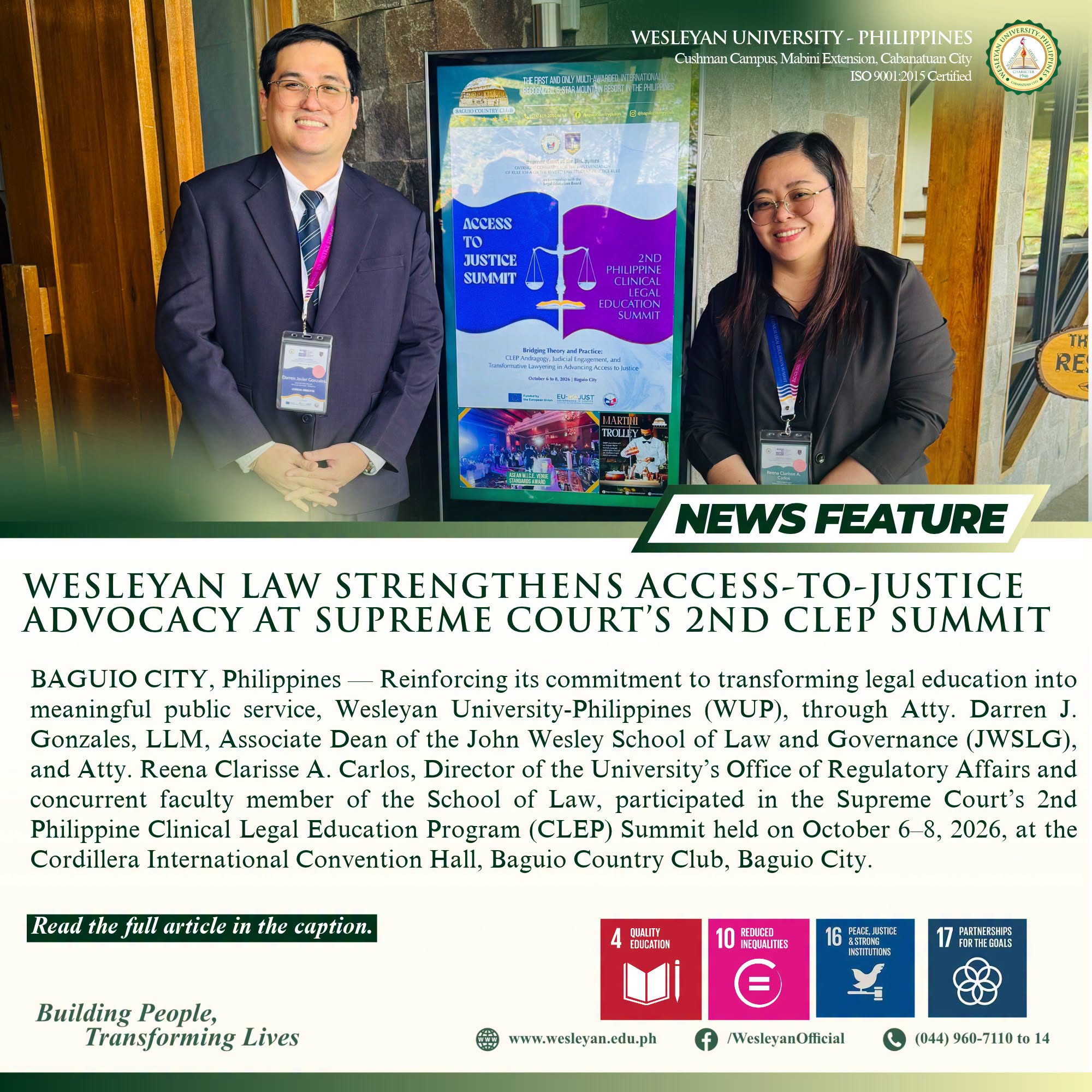
 BAGUIO CITY, Philippines — Reinforcing its commitment to transforming legal education into meaningful public service, Wesleyan University-Philippines (WUP), through Atty. Darren J. Gonzales, LLM, Associate Dean of the John Wesley School of Law and Governance (JWSLG), and Atty. Reena Clarisse A. Carlos, Director of the University’s Office of Regulatory Affairs and concurrent faculty member of the School of Law, participated in the Supreme Court’s 2nd Philippine Clinical Legal Education Program (CLEP) Summit held on October 6–8, 2026, at the Cordillera International Convention Hall, Baguio Country Club, Baguio City.The participation of the two Wesleyan legal educators highlighted the University’s continuing engagement in national efforts to strengthen clinical legal education, improve access to legal services, and prepare future lawyers for the practical, ethical, and social responsibilities of the legal profession.
For the John Wesley School of Law and Governance (JWSLG), the Summit’s central message carried particular significance: legal education must extend beyond preparing students to pass the Bar examinations and equip them to serve real clients, address actual legal problems, and help advance justice in their communities.
This direction is consistent with the JWSLG’s ongoing implementation of CLEP, through which law students gain supervised experience in legal practice and develop the competencies necessary to serve individuals and communities, particularly those with limited access to legal assistance.
BRINGING NATIONAL LEGAL EDUCATION REFORMS HOME TO NUEVA ECIJA
The Summit, themed “Bridging Theory and Practice: CLEP Andragogy, Judicial Engagement, and Transformative Lawyering in Advancing Access to Justice,” convened members of the Judiciary, law school administrators, legal aid clinic directors, supervising lawyers, externship partners, and law student practitioners to examine how clinical legal education can become a central pillar of lawyer formation.
Constituted by the Supreme Court’s Oversight Committee for the Implementation of Rule 138-A, or the Revised Law Student Practice Rule, under the chairpersonship of Senior Associate Justice Marvic M.V.F. Leonen, the event was organized in collaboration with the Legal Education Board (LEB) and the Philippine Association of Law Schools (PALS), with support from the European Union Governance in Justice Programme (EU-GOJUST).
For Wesleyan, participation in this national dialogue provided an important opportunity to engage with emerging standards, institutional practices, and approaches to clinical legal education that may inform the continuing development of its academic and legal aid initiatives in Cabanatuan City and the Province of Nueva Ecija.
The discussions were particularly relevant to the School’s responsibility to ensure that experiential learning is not treated merely as a requirement for graduation or admission to the Bar, but as an integral part of preparing students for responsible and competent legal practice.
By engaging with the Judiciary, regulators, legal educators, and practitioners from other institutions, Wesleyan strengthened its connection to the broader movement to make legal education more responsive to the needs of the public.
ADVANCING A MORE RESPONSIVE CLINICAL LEGAL EDUCATION PROGRAM
A defining moment of the Summit was the keynote lecture delivered by Senior Associate Justice Leonen, titled “Who Counts as a Knower: CLEP Andragogy as a Core Mechanism Toward a Broader Access to Justice.”
Justice Leonen challenged legal educators to rethink the conventional relationship between lawyers and the communities they serve. He emphasized that clinical legal education should develop not only technical competence but also empathy, humility, and an appreciation of the lived experiences of people seeking justice.
“The clinic is where a future lawyer learns to sit patiently, with human empathy and compassion,” he explained, describing clinical education as a setting in which students learn to recognize the limitations of existing legal frameworks and work toward meaningful solutions.
He likewise called for a shift from traditional legal aid toward legal empowerment, emphasizing that marginalized individuals and communities must be recognized as active participants in asserting their rights and pursuing remedies.
These insights reinforce the importance of developing a clinical legal education program that combines sound legal analysis, effective client communication, ethical decision-making, community engagement, and reflective practice.
For JWSLG, such an approach underscored the need to prepare students not only to understand legal rules and procedures but also to listen carefully to clients, appreciate the circumstances underlying their legal concerns, and provide assistance with competence and compassion.
The Summit also featured the keynote lecture of Supreme Court Associate Justice Maria Filomena D. Singh, Vice Chairperson of the Oversight Committee, who emphasized that practice-readiness requires more than familiarity with statutes and doctrines. It entailed the ability to identify legal issues from incomplete facts, explain available remedies clearly, draft accurately, negotiate responsibly, and uphold the dignity of every client.
These discussions affirmed that the quality of legal education must be measured not only by what students know but also by what they can responsibly do with that knowledge.
STRENGTHENING LEGAL AID AND INSTITUTIONAL PARTNERSHIPS
Beyond classroom instruction, the Summit emphasized the need for stronger institutional arrangements that connect law schools, courts, supervising lawyers, legal aid providers, and communities.
A major highlight was the launch of six CLEP manuals and guidebooks designed to support the program’s implementation nationwide. These materials covered curriculum and assessment, clinic operations, clinical faculty, supervising lawyers, externships, and reflective practice.
The resource materials provided a framework for strengthening the delivery of experiential legal education and promoting more systematic approaches to student supervision, competency assessment, and institutional collaboration.
The Summit also examined the relationship between CLEP and the Unified Legal Aid Service (ULAS), which establishes legal aid obligations for covered lawyers and supports efforts to connect qualified beneficiaries with appropriate legal service providers.
In his keynote message on ULAS, Supreme Court Associate Justice Alfredo Benjamin S. Caguioa emphasized that the success of legal aid should ultimately be measured by its impact on people rather than by compliance with prescribed service hours alone.
“ULAS speaks in hours. But its purpose is measured in people,” Justice Caguioa stressed, underscoring the importance of ensuring that legal knowledge reaches individuals who need assistance.
For Wesleyan, these discussions underscored the value of sustained coordination among the School of Law, the legal profession, government institutions, and community partners in expanding access to legal assistance and providing students with meaningful opportunities to learn through service.
They also reinforced the importance of developing sustainable legal aid initiatives supported by capable clinical faculty, supervising lawyers, adequate institutional resources, and effective referral mechanisms.
FROM LEGAL EDUCATION TO COMMUNITY IMPACT
The Summit’s broader message was that clinical legal education must help transform the relationship between the legal profession and the communities it serves.
In his post-panel discussion, Justice Leonen stressed that legal aid and legal empowerment must address not only individual disputes but also the structural conditions that perpetuate marginalization. He likewise emphsized the need for adequate resources and sustained institutional commitment to support legal education reforms and community-centered legal services.
This perspective was especially relevant to law schools serving communities where access to legal assistance may be constrained by financial, geographic, or institutional barriers. In such settings, a well-supported legal aid clinic can serve as both a training ground for future lawyers and an important link between the legal system and the public.
For JWSLG, the challenge was to continue strengthening the connection between academic instruction and the realities of legal practice, ensuring that supervised student engagement with actual clients contributes to professional formation while respecting the rights and interests of those receiving assistance.
The participation of Atty. Gonzales and Atty. Carlos reflected Wesleyan’s engagement in this continuing national conversation and its recognition that legal education is a shared responsibility involving academic institutions, the Judiciary, regulators, practitioners, and the communities whose lives are affected by the law.
A CONTINUING COMMITMENT TO JUSTICE AND SERVICE
The 2nd Philippine CLEP Summit concluded with a renewed call for stakeholders to strengthen institutional partnerships, sustain investment in clinical legal education, and cultivate lawyers whose professional competence is matched by their commitment to justice.
For WUP, the Summit reinforced an enduring institutional responsibility: to prepare future members of the Bar not merely to practice law, but to use their knowledge and skills in the service of the public.
Through the continued development of clinical legal education, legal aid, and community engagement, the JWSLG can further contribute to expanding access to justice in Nueva Ecija while aligning its educational practices with the evolving direction of Philippine legal education.
The participation of two WUP legal educators thus represented more than attendance at a national gathering. It reflects Wesleyan’s continuing engagement with the institutions and ideas shaping the future of legal education, as well as the University’s responsibility to translate these developments into meaningful opportunities for student learning and public service.
Ultimately, the Summit affirmed a principle that remains central to Wesleyan’s role in legal education: the true measure of a lawyer’s education is not only the mastery of the law, but also the ability to use that knowledge responsibly, compassionately, and effectively to improve the lives of others.
Wesleyan University-Philippines advances its commitment to practice-ready lawyers, community-centered legal aid, and people-centered justice through the participation of Associate Dean Atty. Darren J. Gonzales, LLM, and Atty. Reena Clarisse A. Carlos in the national gathering on clinical legal education.
Article by Atty. Darren J. Gonzales
Photos Courtesy of Atty. Darren J. Gonzales and the Supreme Court of the Philippines.