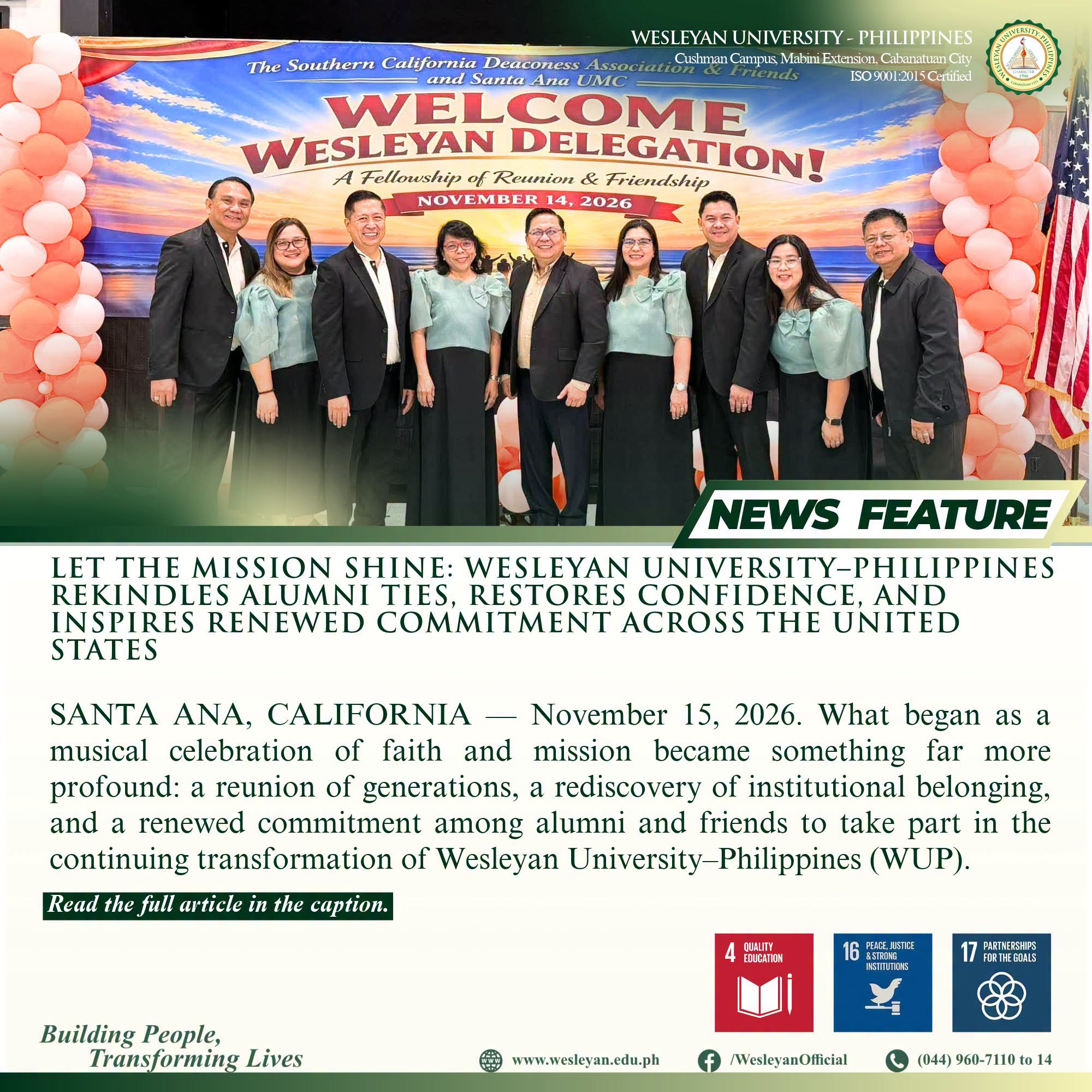
 SANTA ANA, CALIFORNIA — November 15, 2026. What began as a musical celebration of faith and mission became something far more profound: a reunion of generations, a rediscovery of institutional belonging, and a renewed commitment among alumni and friends to take part in the continuing transformation of Wesleyan University–Philippines (WUP).
Let the Mission Shine: Called by Christ, Sent in Love event brought the university’s unfolding story of recovery, institutional renewal, and aspirations for the future to Southern California, where 76 alumni and friends gathered to reconnect with an institution that had helped shape their lives, professions, and values.
Organized by the Southern California Deaconess Association and Friends, in partnership with the Santa Ana United Methodist Church Filipino Ministry, the November 14 gathering at Santa Ana United Methodist Church provided an opportunity for fellowship, reflection, musical witness, and a candid conversation about the University’s accomplishments and continuing challenges.
At the heart of the event was a keynote presentation by WUP President Dr. Irineo G. Alvaro Jr., titled “Wesleyan Rising: A New Era of Purpose and Progress,” followed by an open forum that allowed alumni and friends to ask questions, revisit concerns, and gain a clearer understanding of the University’s direction.
The Wesleyan Executive Voices, composed of members of the University executives, offered a musical repertoire that gave artistic expression to the very mission the gathering sought to reaffirm.
Yet beyond the music, speeches, and institutional reports, the most compelling story emerged from the people themselves—graduates separated by decades, professions, and continents, but drawn together by a shared identity and an enduring concern for their alma mater.
For many, the gathering became an opportunity not merely to remember Wesleyan as it once was, but to rediscover what Wesleyan is becoming.
A Homecoming That Reawakened Hope
For Deaconess Perla Cunanan Baker, president of the Southern California Deaconess Association and Friends and principal organizer of the gathering, the success of the event was evident even before the formal program began.
“I saw it in the room. We set aside an hour for welcome and social time before lunch, and it quickly turned into a homecoming. There were new faces, yet it felt like the same school family. Old schoolmates found each other, new friendships began, and you could feel a new fire of reconnection,” Baker recalled.
Her observations captured the significance of bringing together graduates and supporters whose relationships with the University had been shaped by both cherished memories and institutional disappointments.
Baker acknowledged that some alumni had initially been reluctant to participate because of concerns arising from the University’s reputation during previous years.
“Some graduates had hesitated to come because the school’s reputation had been bad for so long. Seventy-six people came anyway, and they came to listen and ask questions,” she said.
What followed, however, was a change in the atmosphere.
“After the President’s presentation and the open forum, I saw bright faces, ear-to-ear smiles, and nodding heads. It was as if they had been given fresh breath.”
For Baker, the President’s report offered tangible reasons for renewed confidence. She pointed to improvements in campus facilities, the mentoring and empowerment of local personnel, scholarship opportunities for financially disadvantaged students, and initiatives such as SHARE, which she described as serving deaf and non-speaking individuals.
She also cited institutional recognition, student achievements, the continuing strength of the College of Nursing, and improvements in campus operations as encouraging signs.
These developments, she observed, reflected more than physical restoration. They suggested a changing institutional culture—one increasingly attentive to accountability, humility, and the dignity of its people.
“The challenges are not over. A school that has been through hard years still needs the family that loved it,” Baker emphasized.
Her appeal to the global Wesleyan community was both personal and practical:
“Let go of the old disappointments, because the story has turned. Come back with your prayers, your presence, your gifts, your time, and your voice. Support the scholarships, encourage the students, and speak well of what is good while helping with what still needs work.”
For the organizer, the mission would become meaningful only when the renewed enthusiasm translated into continuing involvement.
“Wesleyan was founded to prepare people to serve. Now that it is shining again, let us help it shine brighter, so that ‘Let the Mission Shine’ is not just the name of an event but a promise we keep together.”
From a Broken Seal to a Sacred Calling: The Story of Wesleyan Rising
Rather than presenting progress merely as a succession of accomplishments, Alvaro placed the University’s journey within the larger context of leadership, responsibility, healing, and institutional transformation.
Recalling his formal installation in December 2023, he explained why he had entitled his inaugural address “The Sacred Calling.”
“I chose those words deliberately because I did not regard the presidency as merely an executive position, a professional appointment, or another leadership opportunity. I saw it as something far greater: a sacred responsibility entrusted by God, a calling to serve, and a covenant to help restore an institution that had given so much to generations of Wesleyans.”
Using the metaphor of a broken seal, Alvaro described the condition of the institution when he assumed leadership.
“If I were to describe its condition metaphorically, I would say that I had inherited a university with a broken seal—a once-cherished institution whose spirit had been wounded and whose sense of purpose had been shaken.”
He spoke of an institutional environment marked by weakened morale, strained relationships, fear, distrust, and diminished confidence in leadership.
Rebuilding Wesleyan, therefore, could not be accomplished through infrastructure improvements or administrative measures alone.
It required the restoration of trust, the renewal of relationships, the recovery of institutional confidence, and the awakening of a community’s collective capacity to move forward. But amid those difficulties, Alvaro discovered something that would shape his leadership.
“Wesleyan was more than ready to rise,” he declared.
“Beneath the years of uncertainty, fear, and distrust was a community that had not lost its potential, a university whose greatness had not disappeared, and a spirit that was simply waiting to be awakened.”
Progress Made Visible
The President’s presentation brought the alumni into the ongoing work of institutional renewal, highlighting initiatives in facilities development, organizational governance, employee empowerment, academic quality, community engagement, and international visibility.
Among the developments associated with the University’s transformation are campus road and drainage rehabilitation, improvements to university facilities, construction and upgrading of campus gates, expansion of administrative spaces, improvement of institutional records storage, and continuing work on the
International Guest House and other service facilities.
These physical developments are accompanied by efforts to strengthen governance systems, operational accountability, personnel policies, and institutional financial stewardship.
In health education and community service, ongoing developments include the strengthening of Wesleyan University–Philippines Hospital operations, professional engagements with physicians, and initiatives supporting the delivery of healthcare services.
Beyond the campus, WUP’s growing international engagement has included recognition in the 2026 World University Rankings for Innovation (WURI), where the University was recognized among the global top 500.
Together with the student achievements, nursing education developments, scholarship initiatives, and improvements in University services highlighted during the gathering, these efforts provided alumni with a broader picture of an institution seeking to restore confidence while opening new possibilities.
The achievements, however, were not presented as reasons for complacency. Rather, they underscored the continuing need for sound leadership, responsible stewardship, transparent decision-making, and sustained support from the wider Wesleyan community.
“Our story is no longer defined by the challenges we inherited but by the possibilities we are creating together”, Alvaro said.
For the alumni gathered in Santa Ana, this message gave renewed meaning to an institution many had known for decades.
An Alumni Community Rediscovering Its Voice
Among those visibly encouraged by the presentation was Samuel Pascual, a 1969 Bachelor of Arts graduate of Wesleyan, president of the Wesleyan University–Philippines Alumni Association and CCAC, Inc., and a former pharmaceutical representative in the Philippines and United States.
For Pascual, the presentation offered a compelling response to the questions and concerns that had surrounded the University’s previous administrations. “My connection to my Alma Mater was definitely renewed and rejuvenated by your impressive video presentation,” he said. “It was very refreshing to hear how far the current leadership has managed to reverse the failed policies and financial mismanagement of the past administrations.”
Pascual expressed particular appreciation for what he perceived as the openness of the University’s current leadership.
As he emphasized during the question-and-answer session, Wesleyan’s story deserved an audience extending far beyond Southern California. “This presentation deserves a bigger audience that should reach every Wesleyanian throughout the globe.”
“It was a breath of fresh air learning that our beloved University is now in good hands. As a Wesleyan graduate, it certainly inspired me to reconnect and to participate in spreading the good news to all our members in California.”
He also commended President Alvaro’s leadership team for what he described as its “transparency and unwavering commitment to propel our University to greater heights.”
His reflections revealed one of the event’s most important outcomes: renewed institutional confidence accompanied by a willingness to become an active messenger of Wesleyan’s continuing story.
Beyond Pride: Alumni Responsibility and Institutional Partnership
Jennifer Sanchez, currently Director of Student Affairs at Pacific College in Costa Mesa, California, an institution under Westcliff University, said that the gathering offered a deeper understanding of alumni identity and responsibility.
Sanchez completed her Bachelor of Arts in Political Science in 2000 and later earned her Bachelor of Science in Nursing in 2010 from Wesleyan University-Philippines.
“The event rekindled a deep sense of pride in me—not only in knowing where I started, but in seeing how far Wesleyan has come and how its mission continues to evolve and impact lives,” she reflected.
“It was a meaningful reminder that our connection to Wesleyan goes beyond the years we spent in school. We remain part of a community and a mission that continue long after graduation.”
Sanchez, said that the value of the gathering lay not simply in celebrating institutional achievements but also in recognizing the responsibility that comes with being part of the University’s continuing journey.
“Seeing its accomplishments, its challenges, and the work it continues to pursue made me appreciate the institution on a much deeper level.”
She underscored that sustaining an educational institution is not solely the responsibility of its present administrators.
“As alumni, we have a role to play. I hope more of us take the time to recognize Wesleyan’s value, reconnect with its purpose, and develop a greater sense of responsibility toward the community that helped shape us.”
Her appeal was anchored in three memorable imperatives: “Look back, give back, and keep track.”
To look back, she explained, is not simply to reminisce but to recognize the experiences, opportunities, and relationships through which Wesleyan helped shape the paths its graduates eventually pursued.
To give back is to recognize that alumni contributions need not always be financial.
“Giving back does not always have to be financial. It can be through our time, our knowledge, our presence, our connections, or simply our willingness to support the next generation.”
To keep track, meanwhile, is to remain informed about the University’s evolving priorities, accomplishments, and unfinished work.
“We cannot genuinely support an institution if we are disconnected from its story. Let us continue to follow its progress, celebrate its milestones, and help keep it on track toward the mission it has committed itself to.”
Sanchez’s reflections moved the discussion beyond nostalgia toward a more enduring form of partnership—one grounded in informed engagement, shared responsibility, and action.
“Wesleyan gave many of us a starting point. I believe we owe it to that beginning—and to those who will come after us—to remain connected and help make its future even brighter.”
Turning Disappointment into Sustained Commitment
Eleanor Pascual-Serrano, a 1972 Bachelor of Arts in English graduate, who worked as a bookkeeper and office manager, said that the University’s renewed direction carried particular significance.
Serrano had continued supporting Wesleyan through scholarship initiatives despite her disappointment over the University’s difficulties in previous years.
“After disappointing events during the past administrations, it is reassuring to know that we are moving forward past the shackles of corruption that held
Wesleyan back for so many years,” she said, expressing her personal assessment of the institution’s past.
“But even during those darkest days, I have never lost my resolve to give back and support Wesleyan through scholarships.”
Her testimony highlighted a form of alumni loyalty that endured even when institutional circumstances were discouraging.
For Serrano, the present moment offers an opportunity to translate renewed confidence into sustained collective action.
“To my fellow alumni, there is a new era at Wesleyan. Finally, our Alma Mater is standing up for its threefold mission of scholarship, service and character.”
She encouraged fellow graduates to make regular contributions, however modest, to support the University’s work and its students.
Drawing from a familiar Filipino metaphor, she compared the collective strength of alumni to the individual twigs of a traditional broom, or walis na tingting.
Like individual twigs that become stronger when bound together, small acts of generosity, she explained, can collectively make a significant difference in the lives of students, personnel, and the surrounding community.
Her perspective reinforced a crucial principle of institutional partnership: meaningful change is not measured only by the magnitude of individual gifts but also by the consistency and collective strength of those willing to give.
A Mission That Embraces Friends Beyond the Alumni Community
The gathering also demonstrated that Wesleyan’s influence extends beyond its graduates.
Ana Naval, a friend of Wesleyan, currently a Neuroscience Intensive Care Unit Registered Nurse at Los Angeles County Hospital, saw the event as an affirmation of the University’s capacity to unite people through shared values.
“I find this renewed connection so beautiful because it reminds me that Wesleyan University is more than just a place to learn; it’s a community where we share values, faith, purpose, and service,” Naval said.
For her, the significance of Let the Mission Shine lay in its ability to strengthen relationships and inspire people to carry the University’s mission beyond geographic and institutional boundaries.
“The ‘Let the Mission Shine’ event brings us all together, makes us feel more connected, and encourages us to keep the university’s mission alive.”
“It brings back our pride, strengthens our bonds, and reminds us that no matter where life takes us, we’re always part of the Wesleyan family.”
Her reflections demonstrated that an institution’s mission can find support among individuals who may never have studied within its classrooms but nevertheless identify with its educational, spiritual, and humanitarian commitments.
That same understanding resonated with Myrna Arucan, a Wesleyan Bachelor of Science in Nursing graduate, Batch 1993, who also holds MSN, RN, and PCCN credentials and whose professional experience includes service as Clinical Supervisor at Providence Saint John’s Health Center and Clinical Coordinator at Henry Mayo Newhall Hospital.
For Arucan, the renewed relationship represented an opportunity to reaffirm a shared commitment to faith, service, and making a difference.
“I see WUP and its mission as an opportunity to reaffirm a shared sense of purpose, faith, service, and commitment to making a difference.”
She emphasized that the University’s mission must continue to evolve without losing its foundational values.
“It also suggests that WUP mission should be more than words or institutional history. It should be visible through its people, leadership, students, alumni, partnerships, and the positive impact they make in the community.”
Arucan regarded the University’s progress as both a reason for gratitude and an invitation to remain engaged.
“Every success is a reason for gratitude, while every challenge is an invitation to renew our commitment.”
She urged fellow graduates and supporters to move beyond passive expressions of institutional pride.
“Let us be more than proud alumni. Let us be active partners in Wesleyan’s continuing story.”
Her closing challenge captured the practical significance of the gathering: “The best way to let the mission shine is to live it, support it, and pass it on.”
Similarly, Loida Arucan Iff, a Bachelor of Science in Nursing graduate, Batch 1980, and retired operating room registered nurse in Switzerland, described the gathering as a renewal of relationships and shared responsibility.
“I see the renewed connection and opportunity to reaffirm a shared sense of purpose, strengthen relationships, and turn common values into meaningful action.”
For Iff, reconnecting with an institution must lead to commitments that create lasting value.
“‘Let the Mission Shine’ should mean more than renewing a relationship; it should mean renewing a commitment to a mission that creates lasting value.”
She reminded fellow alumni that graduation does not terminate their relationship with the University or their responsibility to the values it helped cultivate.
“Wesleyan’s mission does not end at graduation, nor is it confined to the university campus. It lives on through every person whose life has been shaped by the institution.”
Her message reflected a sense of continuity between generations.
“Together, let us honor our past, strengthen our present, and build a brighter future for Wesleyan University.”
Across these testimonies, a common conviction emerged: the University’s future cannot rest exclusively on what its present leadership accomplishes. It must also be strengthened by the continuing participation of graduates, friends, supporters, and partners who believe in its purpose.
The event’s central message was reinforced through the musical repertoire presented by the Wesleyan Executive Voices, whose performances transformed the gathering into an expression of faith, compassion, and shared purpose.
President Alvaro’s message of a University rising beyond its past found its counterpart in the alumni’s willingness to participate in shaping its future.
The mission was no longer confined to the physical campus in Cabanatuan City. It had found renewed expression in the hearts and commitments of people thousands of miles away.
Ultimately, Let the Mission Shine did more than reconnect a University with its graduates and friends in the United States. It reopened relationships, renewed confidence, encouraged accountability, celebrated faith, and invited a global community to become active participants in a shared mission.
The event’s enduring significance lies not only in the music performed, the achievements presented, or the friendships rekindled, but in what those experiences may continue to inspire.
Let the mission shine not merely in what Wesleyan remembers of its past, nor only in what it celebrates today, but in the lives it transforms, the opportunities it creates, the people it serves, and the future its community chooses to build together.
For a University that has journeyed through difficult years and continues to rise with renewed purpose, the mission has found fresh voices beyond its shores.
The gathering has ended. The reconnection has begun. And the mission continues.
Words by Gladys P. Mangiduyos
Photo Courtesy of the OVAAP