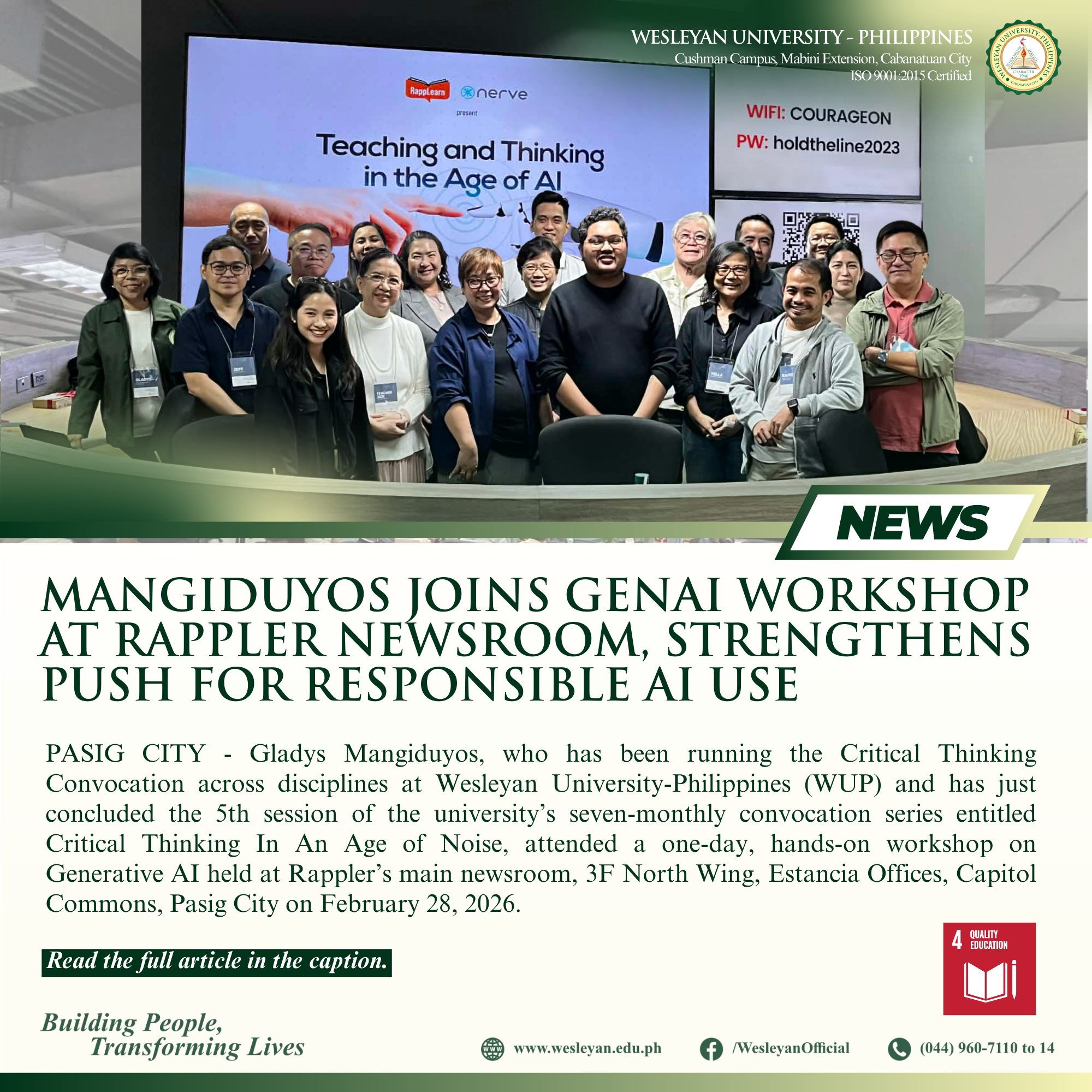
 PASIG CITY – Gladys Mangiduyos, who has been running the Critical Thinking Convocation across disciplines at Wesleyan University-Philippines (WUP) and has just concluded the 5th session of the university’s seven-monthly convocation series entitled Critical Thinking In An Age of Noise, attended a one-day, hands-on workshop on Generative AI held at Rappler’s main newsroom, 3F North Wing, Estancia Offices, Capitol Commons, Pasig City on February 28, 2026.
The workshop gathered 15 participants and was designed for Filipino professionals who want to make sense of Generative AI and apply it responsibly in the workplace. Moving beyond both hype and fear, the session blended clear, foundational explanations of how GenAI tools work with practical exercises on using them for real-world tasks and decision-making.
Glenda Gloria, Rappler’s executive editor, said,
“Before social media was good, but a lot of things have changed, we are all grappling with how fast moving the world has been, as if we are all riding on a train that does not stop, and while we are moving so fast we must know and understand, and that understanding we must know its limit.” Gloria continued saying that in RappLearn, “we look at AI not just in research but based on insights and our day-to-day experience, dealing with the opportunities AI gives at the same time, problems.”
Throughout the day, participants examined how AI is reshaping work globally and why this shift is especially critical for Filipino professionals and organizations preparing for the future. Facilitators guided the group in describing Generative AI in simple, non-technical language, helping to remove intimidation and clarifying why these tools can produce errors, hallucinations, or misleading outputs. The training then turned practical: participants used AI tools for workplace applications, practiced basic prompt engineering techniques, and evaluated AI-generated content with a critical lens, checking for accuracy, bias, and usefulness. The workshop consistently returned to a central principle: AI should enhance, not replace human judgment, accountability, and critical thinking.
The session also addressed the cognitive and ethical risks of AI-enabled speed and scale, equipping participants with strategies to protect human-centered decision-making in an AI-augmented workplace.
The workshop was led by Gemma Mendoza, who leads Rappler’s multi-pronged efforts to address disinformation through big-data research, fact-checking, and community workshops, her expertise in running community workshops and combating disinformation provides a crucial foundation for building the digital literacy and critical thinking skills; and by Don Kevin Hapal, Head of Data and Innovation at The Nerve, a digital forensics consultancy born from Rappler’s investigative work. Their combined expertise anchored the day’s emphasis on verification, responsible use, and building digital literacy skills that keep pace with emerging technologies.
Mangiduyos’ participation aligns closely with the thrust of WUP’s ongoing convocation series, where critical thinking is framed not only as an academic skill, but as a practical discipline for navigating complex realities especially in a time when machines can generate content in seconds, but truth, ethics, and wise judgment still require human responsibility.
“Anyone who wishes to become ethical in using the tool must have an informed use. We have to understand how the models are used.” Mangiduyos said.
Article and photos by Gladys P. Mangiduyos