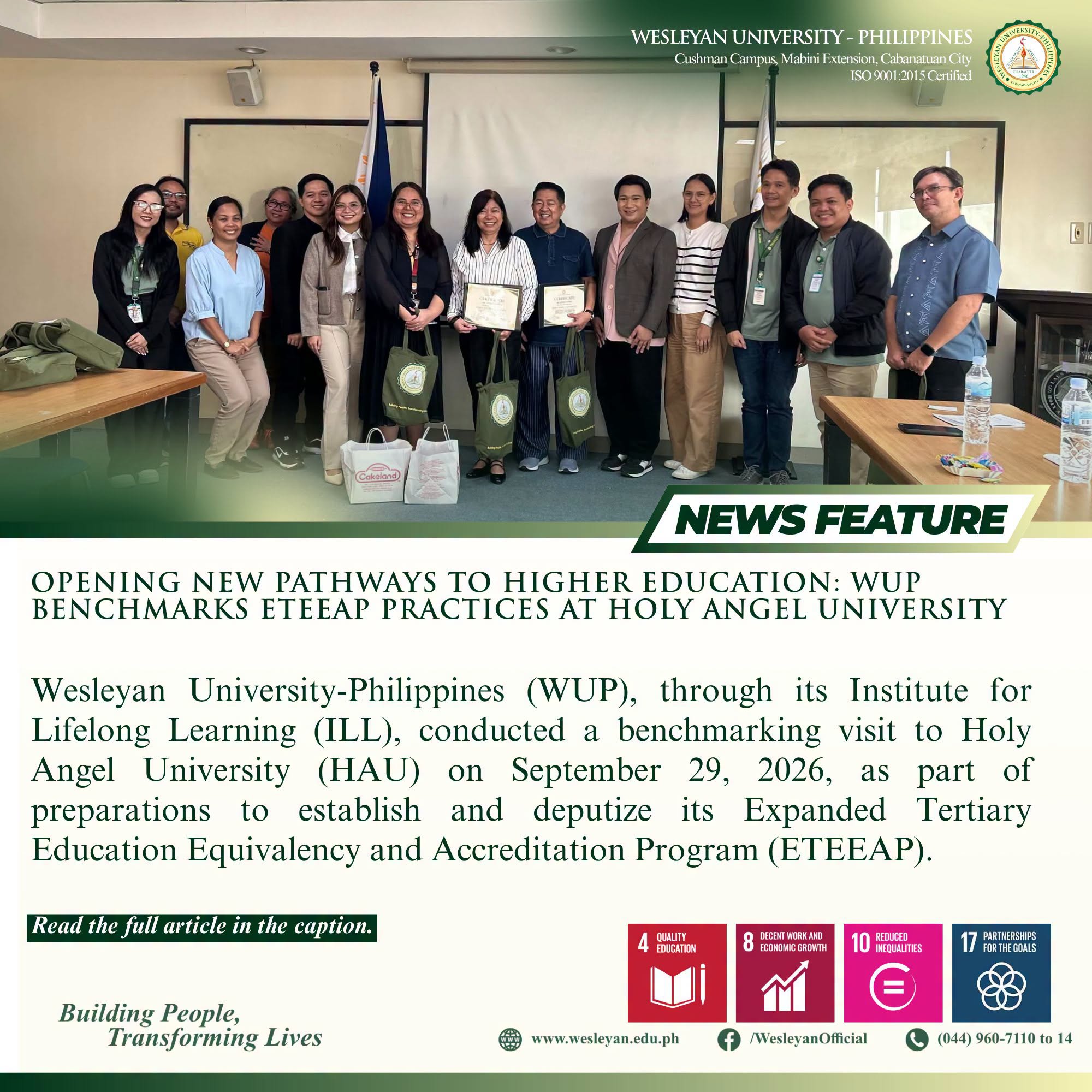
 Wesleyan University-Philippines (WUP), through its Institute for Lifelong Learning (ILL), conducted a benchmarking visit to Holy Angel University (HAU) on September 29, 2026, as part of preparations to establish and deputize its Expanded Tertiary Education Equivalency and Accreditation Program (ETEEAP).Leopoldo Jaime N. Valdez Jr., President of Holy Angel University, welcomed the delegation. The activity provided WUP with insights into the institutional requirements, its implementation processes, and quality assurance mechanisms necessary to develop a credible, accessible, and sustainable ETEEAP program.
Janette R. Rodriguez, Director of HAU’s Institute for Academic Innovation and Entrepreneurship (IAIE), shared institutional practices that deepened the delegation’s understanding of effective ETEEAP implementation. Raymond L. Patterson, Head of HAU’s Performing Arts and Protocol Office, assisted and guided the WUP team throughout the benchmarking activity and introduced the speakers during the program, ensuring a smooth and professionally coordinated exchange.
The discussions covered institutional readiness, applicant screening and eligibility, portfolio assessment, assessor training, worksite validation, competency assessment, intervention mechanisms, documentation, quality assurance, and organizational and administrative requirements. These insights would help guide
WUP in strengthening its own ETEEAP Strategic Plan and Manual of Operations, developing standardized application and assessment procedures, utilizing the learning management system for portfolio submission, preparing assessors, and establishing worksite validation and intervention mechanisms.
The team included representatives from College of Business and Accountancy (CBA), College of Hospitality, Tourism and Management (CHTM), College of Engineering and Computer Technology (CECT), Quality Assurance Office (QAO), and Institute for Lifelong Learning (ILL). Their participation reflected the university’s commitment to a coordinated, institution-wide approach that integrates academic expertise, quality assurance, and program development.
Insights and Reflection from WUP’s Delegation
Jelwin Bautista, CBA Dean, highlighted ETEEAP’s potential to recognize prior learning and expand access to higher education through the Bachelor of Science in Business Administration offering.
“ETEEAP recognizes both formal and informal learning experiences, giving individuals the opportunity to earn a degree by having their knowledge and skills assessed and evaluated. I see great potential for WUP, particularly for our Bachelor of Science in Business Administration, which we are planning to offer through ETEEAP. This will open doors of opportunity for prospective students while expanding the university’s reach and providing more accessible pathways to higher education.” Bautista stated.
“I learned that for us to implement the program effectively at WUP, we need a clear process, well-prepared assessors, and strong partnership with industries. I believe WUP has great potential to grow in ETEEAP, and by learning from other institutions and improving our own practices, we can make the program more accessible and beneficial to those who want to earn a degree while recognizing the knowledge and experiences they have gained through the years.” Dulce Amor Padilla, CHTM Dean, explained.
Jason Villaroman, Director of QAO, underscored the importance of embedding quality assurance throughout the program’s implementation.
“Quality assurance must be integrated into every stage of ETEEAP implementation to ensure that assessment processes, documentation, and institutional practices meet regulatory standards while promoting fair, transparent, and outcomes-based recognition of prior learning.”
Leah Sambat of the ILL highlighted teamwork, flexibility, and continuous improvement as essential to responsive ETEEAP implementation.
“I learned that teamwork, flexibility, and commitment to quality are essential in making ETEEAP more accessible, efficient, and responsive to the needs of learners. By strengthening industry partnerships, improving assessment processes, and adopting best practices from benchmarking, WUP can provide more flexible, accessible, and quality education.”
Luel Mateo of the ILL noted that ETEEAP has the potential to recognize work experience and open meaningful educational opportunities for qualified individuals.
“ETEEAP gives people a chance to have their hard-earned knowledge, skills, and experiences recognized, even those gained outside the traditional classrooms. I realize that making this program successful goes beyond meeting requirements; it takes genuine commitment, teamwork, and a shared understanding that education should create opportunities for people to grow and achieve their dreams.
I see WUP’s ETEEAP as an opportunity to make a real difference in the lives of people who have gained valuable experience through years of work but have yet to earn a degree. WUP can build a program that not only meets the necessary standards but also opens doors, recognizes people’s potential, and brings lifelong learning closer to those who need it.”
CECT faculty members Harry Rolle and Engr. Galilee Villar highlighted the importance of evaluator training, fair assessment, and compassion in recognizing competencies gained through professional experiences.
“Our experience during the ETEEAP Program Benchmarking at Holy Angel University was truly meaningful and inspiring, especially in understanding how the program helps individuals who are already working in the industry earn a college degree by recognizing their knowledge, skills, and professional experiences.
What struck us most was HAU’s emphasis on training evaluators to properly assess students’ competencies and award the maximum credits justified by their prior learning and work experience. Beyond the evaluation process, I was inspired by the importance of compassion and understanding among evaluators, recognizing that ETEEAP is not only about granting academic credits but also giving deserving individuals the opportunity to complete their education, graduate, and achieve their dreams.”
Advancing Accessible and Quality-Assured Education
ETEEAP was designed to provide qualified individuals with an alternative pathway to a college degree by recognizing prior learning, professional experience, training, and demonstrated competencies. The benchmarking reinforced WUP’s commitment to establishing a program that balances regulatory compliance, systematic assessment, industry collaboration, and learner-centered practices.
WUP would use the insights gained to strengthen its institutional readiness and develop an ETEEAP program that upholds academic standards while creating meaningful educational opportunities for qualified learners.
Supporting the United Nations’ Sustainable Development Goals
WUP’s ETEEAP initiative would support the United Nations’ Sustainable Development Goals (SDGs), particularly:
SDG 4: Quality Education – by promoting inclusive access to higher education, recognizing prior learning, and expanding opportunities for lifelong learning.
SDG 8: Decent Work and Economic Growth – by enabling qualified working professionals to have their competencies recognized and pursue academic qualifications that may support career development.
SDG 10: Reduced Inequalities – by providing alternative educational pathways for qualified individuals whose work experience and prior learning may not have been recognized through traditional routes to a college degree.
Through this initiative, WUP advances its commitments to accessible, equitable, and quality-assured education while contributing to professional development, lifelong learning, and inclusive growth.
Article and Photos Courtesy of Institute for Lifelong Learning